
Series: History of Shimla, Himachal Pradesh, India
Phase 2: Medieval Period — Part 8 of 30
This article forms part of a continuing series that follows the gradual emergence of organised power in the western Himalayas. As small communities gave way to clans, chieftainships, and hill states, patterns of rule, alliance, and conflict began to take shape. This phase examines how authority was negotiated through land, ritual, and warfare, laying the groundwork for regional kingdoms that would dominate the medieval landscape.
Beneath the Pines: An Early Morning in the Shimla Hills
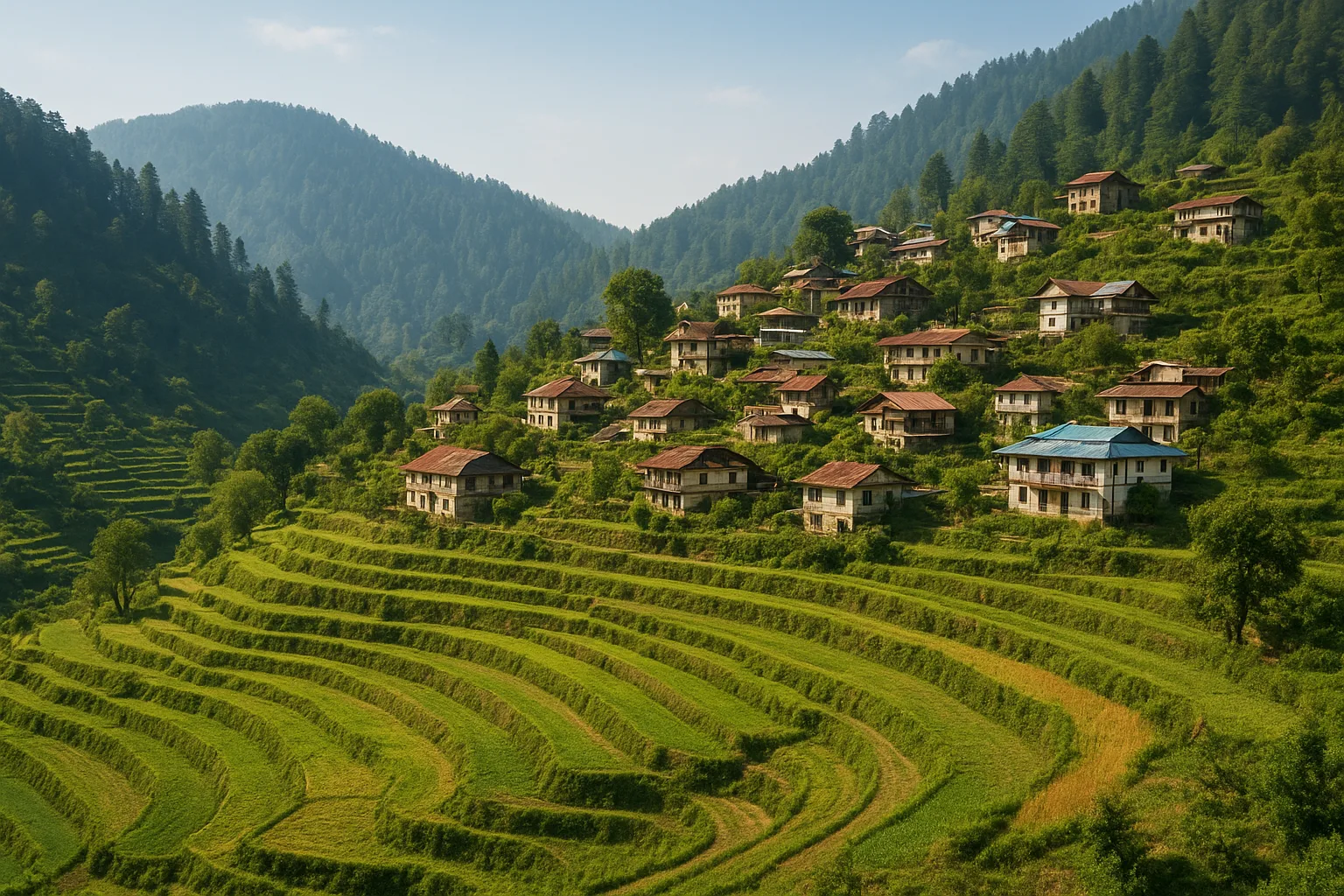
As the first rays of the sun break over the rugged ridges of what is now Shimla, the air stirs with the muted clang of a metal sickle and the distant sound of cattle hooves on dew-wet grass. The scene could belong to any time in the long history of these hills, but it is the medieval centuries—roughly from the twelfth to the sixteenth centuries CE—that lend the landscape its enduring rhythms. High in the Western Himalayas, where dense forests yield to terraced fields and scattered hamlets, the lives of villagers were shaped by the land as much as by the slow, steady march of history.
Geographic and Historical Setting
Situated between the Sutlej and Yamuna rivers, the Shimla hills formed a transitional region—neither entirely part of the Punjab plains nor fully within the high Himalayas. By the early second millennium, these hills were home to scattered agrarian communities whose origins were rooted in earlier migrations, as suggested by both oral traditions and indirect historical evidence.
While the earliest direct documentation of Shimla itself emerges much later, medieval chronicles such as the Gazetteer of the Simla District and local Rajput genealogies refer to the broader region as part of the ancient Trigarta and Kuluta territories. By the thirteenth century, the area was already a crossroads of influence, bordering the emergent hill principalities of Keonthal, Kumharsain, and Bushahr, whose boundaries ebbed and flowed with the fortunes of local chieftains.
Communities and Early Settlements
Oral traditions among the Pahari people trace their ancestry to migrations from the plains and earlier indigenous groups. The Gaddi and Kanet communities, for example, claim descent from Rajput and Khasa settlers, stories passed down through generations but impossible to verify with precision. What is clear from historical inference is that by the medieval period, settlements in the Shimla hills were typically small, clustered around sources of water and cultivable land.
Villages consisted of timber and stone houses, often perched on ridges to maximize sunlight and minimize exposure to wild animals. Extended families formed the basis of social organization, with elders mediating disputes and overseeing communal tasks. Livelihoods depended on a careful balance between agriculture, animal husbandry, and the seasonal collection of forest produce.
Belief Systems and Ritual Life
Local belief systems in the Shimla hills during the medieval period were deeply entwined with the rhythms of the land. Oral traditions recount the worship of regional deities such as Mahasu Devta and Kamru Nag, whose shrines still dot the landscape. These traditions suggest a blending of older animist practices with the growing influence of Hinduism and, to a lesser degree, Buddhism—brought by travelling monks and pilgrims traversing the lower Himalayan routes.
Seasonal festivals, dictated by the agricultural calendar, punctuated village life. Rituals to ensure good harvests or to ward off natural calamities were communal affairs, reinforcing bonds of kinship and collective identity. Priestly roles, often hereditary, connected the spiritual world with the practical concerns of daily survival.
Trade Paths, Barter, and the Local Economy
Despite their apparent isolation, the villages of medieval Shimla were not cut off from the outside world. Historical records and regional gazetteers indicate that old trade and migration routes traversed the hills, linking the Sutlej valley to the plains of Punjab and beyond. Traders and pastoralists would move along these paths, exchanging salt, grains, wool, and metalwork for goods not produced locally.
The economy was largely subsistence-based. Terraced fields supported crops like barley, millet, and buckwheat, while orchards of wild apricot and plum provided seasonal variety. Cattle, goats, and sheep were central to both diet and ritual, with their movement shaping the seasonal rhythms of highland pastures. Barter was the norm, and coins were rare; where they did circulate, they often originated from neighboring hill states or distant plains markets.
The Rise of Hill States and Political Life
Gradually, as population centers grew and local leaders established authority over clusters of villages, the Shimla hills saw the emergence of small principalities. The most prominent among these were Keonthal, Kumharsain, and Bushahr. Early chronicles and genealogies—though composed much later—describe the formation of these states as a process of consolidation, with Rajput chieftains, sometimes claiming descent from mythic heroes, establishing fortified seats of power on accessible ridges.
Political life in the villages remained closely tied to clan loyalties and customary law. While the influence of distant overlords was felt through tribute or periodic levies, daily governance was local and practical. Disputes over land, water, or forest rights were settled by councils of elders or, in cases of inter-village conflict, by negotiation between chiefs.
Continuity and Change: The Medieval Legacy in Shimla
Much of what defines the cultural and social landscape of Shimla today can be traced to the medieval period. The patterns of terraced agriculture, the network of small villages, and the enduring importance of local deities remain visible in the hills. Even as later centuries brought new rulers and external influences, the core rhythms of village life—shaped by the land, the seasons, and communal traditions—persisted.
In the next part of this series, we will follow the gradual consolidation of the Shimla hill states, exploring how shifting alliances and the arrival of external powers began to reshape political and economic life in the region.
Previous: Shimla Region Under the Influence of Bushahr State
Next: Temples and Faith in Pre-Colonial Shimla