
Series: History of Kangra, Himachal Pradesh, India
Phase 1: Ancient Trigarta — Part 3 of 30
This article is part of a broader historical series exploring the earliest layers of human presence in the western Himalayas. Beginning with landscape, belief, and early patterns of movement and settlement, the series traces how communities adapted to mountainous environments long before formal states or written records emerged. These foundational centuries shaped cultural memory, local traditions, and relationships with the land that would endure through later periods of change.
At the Edge of the Ancient World
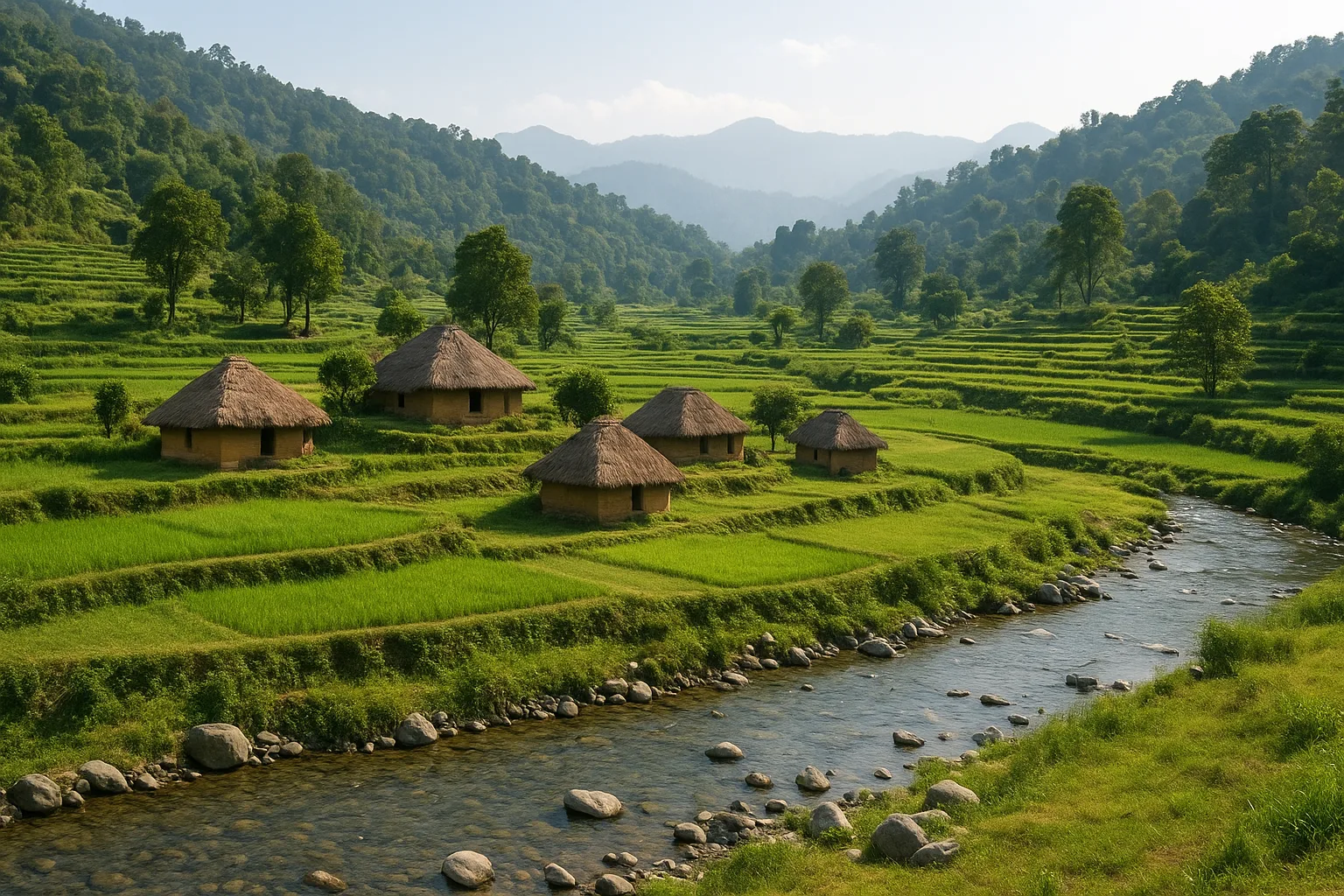
Mist lingers above the Beas River at dawn, veiling the foothills in an ageless silence. In this valley—cradled by the Dhauladhar range and shaped by the shifting waters—human footsteps pressed into the earth long before recorded history began. The Kangra Valley, now famed for its temples and fortresses, was once a mosaic of forest clearings and small settlements, its earliest inhabitants living in rhythm with the land that would become the heart of Trigarta.
Between Myth and Memory: The Earliest Traditions
The region’s oldest stories come to us not through stone inscriptions, but through the persistent oral traditions of its people. Kangra’s folk tales speak of ancient rajas, epic battles, and divine interventions. Local families recount descent from warriors mentioned in the Mahabharata, where the land is described as Trigarta—one of the prominent kingdoms allied with the Kauravas. While these connections stir the imagination, historians approach them with cautious reverence. Oral traditions, though not always literal, encode deep truths about identity, continuity, and the ancient stature of Kangra among the hill states.
Yet, myth and memory often entwine. The Puranas reference Trigarta as a kingdom straddling the Beas, Satluj, and Ravi rivers. While such texts blend theology and geography, they serve as early anchors situating Kangra as a recognized center well before the common era, its boundaries shaped as much by legend as by topography.
Archaeological Echoes: Early Settlements and Material Life
Beneath the modern towns and terraced fields, archaeological finds reveal a subtler story. Stone tools—choppers and scrapers—unearthed near Guler and Kangra point to Paleolithic and Mesolithic activity, dating back several millennia. These implements, fashioned from local river stones, tell of a people who hunted, gathered, and slowly learned to cultivate the fertile valley floors.
By the early Iron Age, fragments of pottery and megalithic cairns indicate more settled communities. The valley’s microclimate, protected by the mountains yet open to the Punjab plains, allowed early agriculturists to experiment with barley, wheat, and millets. Villages grew up along the riverbanks, their inhabitants constructing mud-brick dwellings and practicing forms of ancestor worship that survived in later Kangra customs.
While written records remain elusive for this era, the very pattern of settlement—clustered along trade routes and water sources—hints at a society already aware of its strategic importance in the broader Himalayan corridor.
Communities and Belief Systems: The Roots of Kangra’s Identity
The valley was never a cultural monolith. Early Kangra was home to a patchwork of tribes and clans—some linked to Austroasiatic and Tibeto-Burman linguistic roots, others to the Indo-Aryan expansions from the west. The Katoch clan, whose name would later dominate the region’s chronicles, claim descent from these earliest rulers, though their continuous lineage is more tradition than documented fact.
Belief systems here were as varied as the terrain. Animistic practices—worship of rivers, stones, and trees—endured alongside early Vedic rituals. The cult of Devi (the goddess), which would make Kangra a major center of Shakti worship, likely drew upon these ancient fertility and earth-mother traditions, adapting them into forms recognizable in the valley’s later temples and festivals.
On the Crossroads: Trade, Migration, and the Flow of Ideas
Geography made Kangra a crossroads. The valley’s rivers offered both sustenance and passage, linking it to the plains of Punjab and the trade arteries of Central Asia. Early routes skirted the hills, ferrying salt, grains, and metals between the Himalayas and the Indus basin. Settlements like Nagrota and Guler emerged as nodes on these routes, benefiting from the movement of goods, people, and beliefs.
Evidence suggests that by the first millennium BCE, Kangra’s communities were interacting with neighbors far beyond their immediate valleys. The presence of Northern Black Polished Ware—a hallmark of early urbanization in the subcontinent—points to cultural exchanges with the Gangetic plains. Such encounters seeded the valley with new technologies, religious forms, and social hierarchies that would shape its political evolution.
The Rise of Early Hill States
Gradually, as populations grew and competing lineages vied for control, the kernel of organized rule emerged. The Katoch dynasty, enshrined in both oral lore and later Persian chronicles, is said to have forged the first lasting polity in Kangra. While the precise origins are blurred, by the time of Alexander’s campaigns (late 4th century BCE), Greek writers noted the fortified towns and resistant chieftains of the hill country.
Regional gazetteers compiled during the colonial period—drawing on Rajput genealogies and Persian histories—suggest a pattern of small, semi-autonomous hill states. These polities, often centered on commanding heights or river crossings, maintained shifting alliances and rivalries, sometimes uniting against outside threats from the plains or from among themselves.
By the early centuries of the common era, Kangra had emerged as both a spiritual center and a military stronghold, its settlements growing into towns clustered around shrines and forts. The valley’s reputation for resilience—and for the wealth of its temples—was already attracting the attention of rulers and invaders far beyond the mountains.
Legacy of the First Settlers
The imprint of Kangra’s earliest communities remains visible in the landscape: in the placement of villages, the persistence of old clan names, and the annual festivals that recall ancient cycles of sowing and harvest. The valley’s oldest temples, often built atop prehistoric shrines, preserve echoes of rituals that once shaped the daily lives of its inhabitants.
These ancient roots continue to inform Kangra’s sense of place and identity, anchoring its people to a lineage that bridges myth, memory, and history. As we move forward in this series, the next chapter will explore how Kangra’s rise as Trigarta’s heartland set the stage for its legendary fortresses, dynasties, and enduring role in the wider history of North India.
Previous: Kangra in Vedic and Epic Literature
Next: Religion and Society in Ancient Kangra