
Series: History of Kangra, Himachal Pradesh, India
Phase 1: Ancient Trigarta — Part 2 of 30
This article is part of a broader historical series exploring the earliest layers of human presence in the western Himalayas. Beginning with landscape, belief, and early patterns of movement and settlement, the series traces how communities adapted to mountainous environments long before formal states or written records emerged. These foundational centuries shaped cultural memory, local traditions, and relationships with the land that would endure through later periods of change.
On the Banks of the Beas: A Dawn in Ancient Kangra
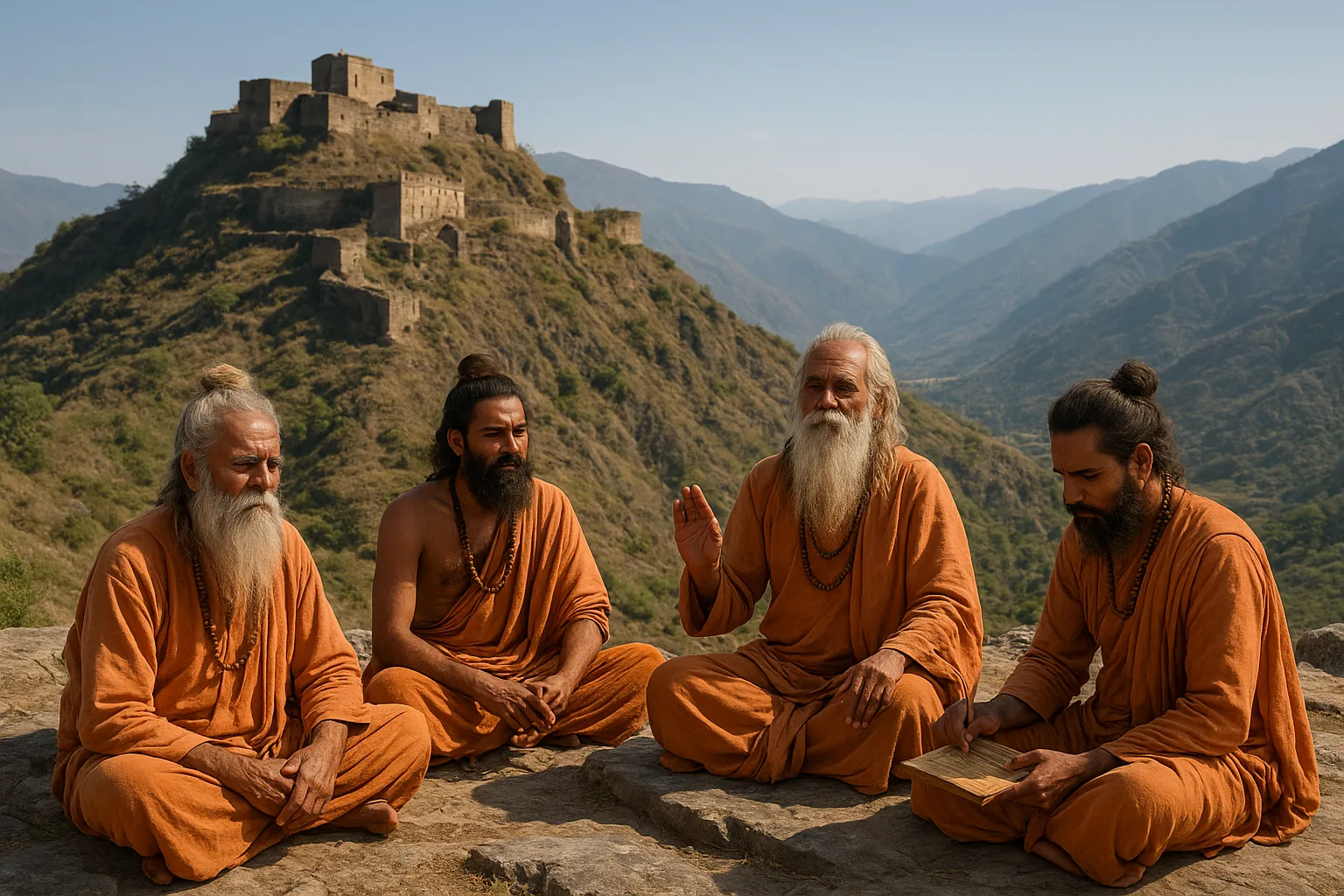
Imagine mist rising over the Beas River as it cuts through the Kangra valley—its banks lined with deodar forests and the distant Dhauladhar peaks shimmering in the pale light. Here, some three thousand years ago, the rhythms of village life blended with the mystery of the wilderness. This was not yet the Kangra of grand forts or painted temples. It was a land at the edge of legend, known to the ancient world as Trigarta—one of the earliest named regions in the Indian subcontinent’s historical memory.
Echoes from the Vedic Age
The earliest glimpses of Kangra emerge faintly through the hymns of the Rigveda (c. 1500–1200 BCE), where rivers and mountains serve as both sacred geography and living boundaries. The Beas (Vipasha) and Sutlej (Shutudri) are invoked, not only as sources of sustenance but also as markers of identity. The people of this region—forebears of later hill communities—likely participated in pastoral migrations, cattle rearing, and the performance of early Vedic rituals beneath the open sky.
Yet, the Vedic texts offer only fleeting allusions. Trigarta itself is not named in the earliest hymns, but its rivers appear as vital arteries. Over time, as the corpus of Vedic literature expanded, the landscape of the western Himalaya began to be imprinted with stories of sages, sacrificial fires, and the contested frontiers between tribal polities.
Between Oral Tradition and Historical Inference
The line between myth and memory is rarely clear in early Indian history. Much of what is known about ancient Kangra comes to us through oral tradition—stories of sages who meditated in forest hermitages, and of local chieftains who claimed descent from legendary lineages. The Mahabharata, composed in its earliest form around 800–400 BCE, introduces Trigarta as a formidable kingdom, ruled by the valorous Susharma Chandra.
Here, Kangra’s place in the epic is both poetic and political. The Trigarta warriors are depicted as skilled archers, allies of the Kauravas, and participants in the great war at Kurukshetra. These tales, passed down and reshaped over generations, became the scaffolding for later claims of antiquity by Kangra’s ruling families. But historians must tread carefully: while these epics encode kernels of historical truth, they are not chronicles in the modern sense, but living texts reflecting the aspirations and anxieties of their audiences.
The Rise of Trigarta: From Legend to Early Polity
By the later Vedic period and into the early centuries BCE, the contours of Trigarta become more tangible. The name—meaning “three hollows” or “three valleys”—likely refers to the river valleys of the Ravi, Beas, and Sutlej. The region’s geography fostered both isolation and contact: mountain passes allowed for interaction with the Punjab plains, while the hills provided refuge and continuity in times of upheaval.
Early settlement patterns reveal a tapestry of clan-based communities, each with their own totems, rituals, and oral genealogies. Over time, some coalesced into nascent hill states. The Trigarta Janapada, mentioned in Buddhist and early Jain sources, is depicted as a politically significant entity, controlling vital routes between the Himalayas and the Gangetic plain. The Kangra valley, with its fertile terraces and defensible terrain, emerged as a center of power and culture.
Belief Systems and the Sacred Landscape
Long before the grand temples of later centuries, Kangra’s hills were alive with sacred groves, megalithic sites, and shrines to local deities. Vedic sacrificial fires likely burned on hilltops, while the forests echoed with prayers to the river goddesses. The region’s spiritual life was shaped by a blend of imported Vedic rituals and indigenous traditions: serpent worship, earth goddess cults, and ancestor veneration persisted alongside newer forms of devotion.
Such syncretism was not unique to Kangra, but here the interplay of highland isolation and cross-cultural exchange fostered a distinctive sacred landscape. Later chronicles, such as the Rajatarangini and the famed Kangra gazetteers, would record legends of sages like Vyasa and Parashurama meditating in these hills—an enduring testament to the valley’s spiritual allure.
Trade, Contact, and the Beginnings of Hill States
The valleys of Kangra were never wholly cut off from the wider world. Early trade routes threaded through the passes, linking the Himalayan foothills with Central Asia, Tibet, and the fertile Punjab. Salt, wool, and precious stones moved along these corridors, carried by traders and itinerant ascetics alike. These exchanges brought not only goods, but also new ideas—ritual technologies, artistic motifs, and political models from across the subcontinent.
By the end of the first millennium BCE, the earliest forms of hill polities began to emerge. These were small, often fractious states—sometimes ruled by local rajas, sometimes by councils of elders. The seeds of Kangra’s later dynasties can be traced to this era, as clan leaders consolidated power and claimed descent from epic heroes to legitimize their rule. The memory of Trigarta persisted, woven into both oral tradition and the emerging consciousness of the region’s people.
Ancient Legacies in Modern Kangra
Today, the echoes of this ancient past linger in every corner of Kangra. The names of rivers and villages, the rhythms of seasonal festivals, and the pride of local lineages are all threads woven from the region’s Vedic and epic heritage. To walk the valley is to sense the weight of time—where the Beas still flows, and stories first sung in the language of the Vedas continue to shape a living landscape.
In the next part of our series, we journey deeper into the early historic period, tracing the transformation of Kangra from a legendary realm to a center of power and faith. The story of Trigarta, begun in the mists of myth, will find new expression in the rise of kingdoms and the forging of a cultural identity that endures to this day.
Previous: Trigarta Kingdom: Ancient Kangra Before Empires
Next: Early Settlements in the Kangra Valley