
Series: History of Solan, Himachal Pradesh, India
Phase 1: Ancient & Early Roots — Part 3 of 30
This article is part of a broader historical series exploring the earliest layers of human presence in the western Himalayas. Beginning with landscape, belief, and early patterns of movement and settlement, the series traces how communities adapted to mountainous environments long before formal states or written records emerged. These foundational centuries shaped cultural memory, local traditions, and relationships with the land that would endure through later periods of change.
Before the Kingdoms: Dawn in the Forested Hills
The first light of day breaks over the hills of Solan, carrying the scent of dew and wild rhododendron. Centuries before forts crowned these ridges or roads wound their way into the valleys, small bands of people gathered around smoky fires, their lives deeply entwined with the land. Imagine a morning thousands of years ago: a circle of huts woven from bamboo and grass, children chasing each other between stands of oak, elders whispering stories of spirits in the woods. To walk the slopes of ancient Solan is to walk among the echoes of these early tribal and agrarian communities—the true architects of its enduring identity.
The Land’s First Inhabitants: Footprints of Early Tribes
Long before Solan was marked on any map, its forested heights and fertile valleys attracted groups of people seeking shelter and sustenance. Archaeological traces—stone tools, pottery shards, and burial cairns—suggest that by the late Neolithic and early Chalcolithic periods, Solan was home to small, semi-nomadic tribes. Oral traditions passed down by later communities speak of the earliest inhabitants as the Koli, Hali, and Chanal—names that still echo in local folklore.
These early tribes were not mere wanderers. They were skilled at reading the land, knowing where to hunt, fish, and gather wild fruits. The dense forests provided not just food but also a spiritual anchor. Rivers like the Giri and the Ashwini, flowing through the region, offered water and fertile silt, gradually giving rise to the first settled communities. Tribal life revolved around seasonal rhythms, with rituals honoring the spirits of the forest, stone, and stream.
From Foraging to Farming: Seeds of Agrarian Life
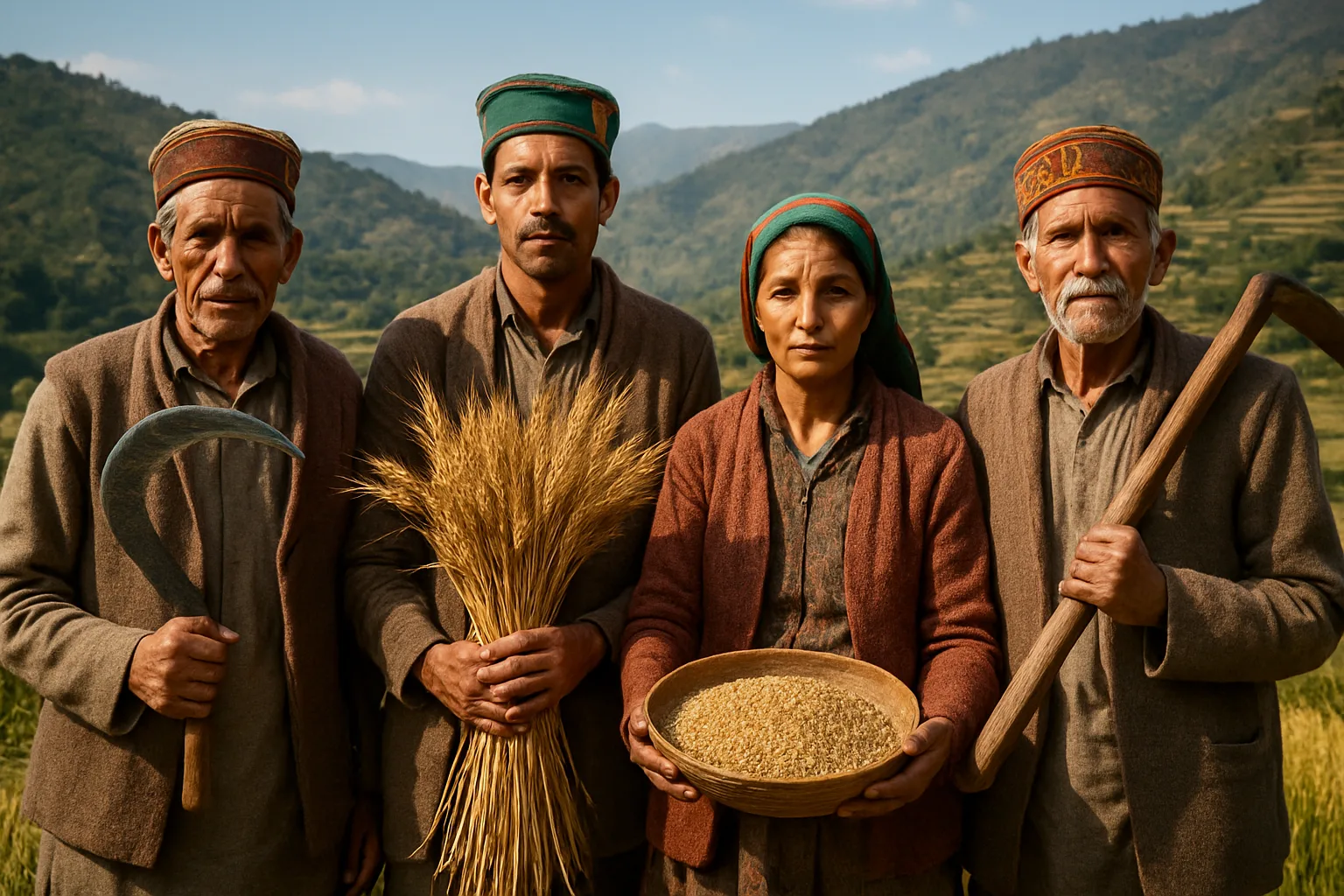
As millennia passed, a subtle but profound shift began. The tribes of Solan, influenced by emerging patterns elsewhere in the North Indian subcontinent, started to experiment with cultivation. The introduction of early grains—millets, barley, and later wheat—transformed temporary camps into permanent villages. The slopes of Kandaghat and Arki, now dotted with apple orchards, were once home to terraced fields carved painstakingly by hand.
This transition did not happen in isolation. The mountains of Solan formed a crossroads between the fertile plains to the south and the high Himalayas to the north. Trade and exchange brought new crops, tools, and even religious ideas. By the early Iron Age, agrarian communities had become the backbone of local society. The land was divided among clans, and disputes were settled under the shade of ancient trees—sometimes with words, sometimes with ritual combat.
Kinship and Clan: The Ties That Bound
Family and kinship shaped every aspect of life in ancient Solan. Extended families, often several generations deep, lived together in clustered hamlets. Authority rested with elders, whose wisdom was sought in times of crisis—whether crop failure, sickness, or inter-clan rivalry. Oral genealogies, recited during festivals, kept alive the memory of ancestors and the boundaries of clan lands.
Village councils, known locally as panchayats, emerged as the arbiters of justice and tradition. These gatherings reflected the egalitarian ethos of the hills, where status depended more on age and experience than on wealth or conquest. Festivals such as Phagli and Maghi brought the community together, blending animist practices with the first hints of Vedic influence filtering up from the plains.
Interplay with Nature: Forests, Spirits, and Survival
To the ancient people of Solan, the forest was both provider and protector. Sacred groves—many still standing today—were believed to house guardian spirits, with elaborate taboos against felling certain trees or hunting in particular glades. Villagers left offerings of grain and flowers at stone shrines, hoping to placate the mountain deities and ensure good harvests. In times of drought or flood, it was to these groves that the desperate turned, seeking signs in the wind and the flight of birds.
Survival demanded a deep knowledge of the landscape. The tribes mastered techniques for managing slopes, building stone terraces to prevent erosion and channel water for their fields. Women gathered wild greens and medicinal herbs, their expertise passed down through matrilineal lines. Livestock—goats, sheep, and sturdy hill cattle—roamed the pastures, watched over by children and dogs.
Early Encounters: Trade, Conflict, and Cultural Exchange
Ancient Solan was never truly isolated. The region’s position at the lower gateway to the Himalayas made it a meeting point for passing traders, wandering ascetics, and occasional raiders. Salt and iron from the plains exchanged hands for honey, wool, and dried fruits. With each transaction came new ideas: rudimentary scripts, metal tools, and the earliest forms of organized religion.
Conflicts, too, were a fact of life. Competition for land and water sometimes erupted into skirmishes between clans, remembered in folk songs as epic encounters. Yet, more often, these interactions led to alliances and intermarriage, weaving together a patchwork of identities that blurred the line between tribe and neighbor. By the early centuries BCE, the seeds of a more complex society had been sown—one that would eventually give rise to the small kingdoms chronicled in later parts of our series.
Traces in the Landscape: Archaeology and Oral Memory
Much of what we know about Solan’s ancient tribes comes from a combination of archaeological finds and the oral memory preserved by later generations. The burial mounds near present-day Nalagarh, the petroglyphs etched into river rocks along the Giri, and the megalithic stones arranged on secluded hilltops—all speak to a world that, while vanished, continues to shape the land beneath our feet. Local legends, told during winter nights, recall the deeds of the ‘first people’—their migrations, their struggles, and their pact with the mountains.
As Buddhist and Hindu influences gradually arrived, many tribal practices were absorbed into the mainstream, their origins forgotten but their forms enduring in the festivals and rituals of today’s villages. The agrarian calendar, the reverence for sacred groves, and the enduring sense of kinship all bear witness to these ancient roots.
The Living Legacy: Solan’s Tribal Spirit Today
Walk through a village in Solan today and you will see the legacy of its early communities in every aspect of daily life. The terraced fields, the communal water tanks, the shrines under ancient trees—all are testaments to a people who not only survived but thrived in a landscape both beautiful and demanding. The sense of community, hospitality, and respect for the land remain strong, even as the region grows and changes.
In honoring the story of Solan’s tribal and agrarian past, we glimpse the wellspring of its resilience and identity. The voices of those first inhabitants still echo in the hills, reminding us that history is not just a record of rulers and battles, but a living tapestry woven from the struggles and dreams of ordinary people. As we move forward in this series, exploring the rise of local kingdoms and the arrival of new cultures, the spirit of these early communities will remain our guiding thread—linking Solan’s ancient roots to its vibrant present.
Previous: Geography That Shaped Early Life in Solan
Next: Solan’s Position in Ancient Trade and Migration Routes