
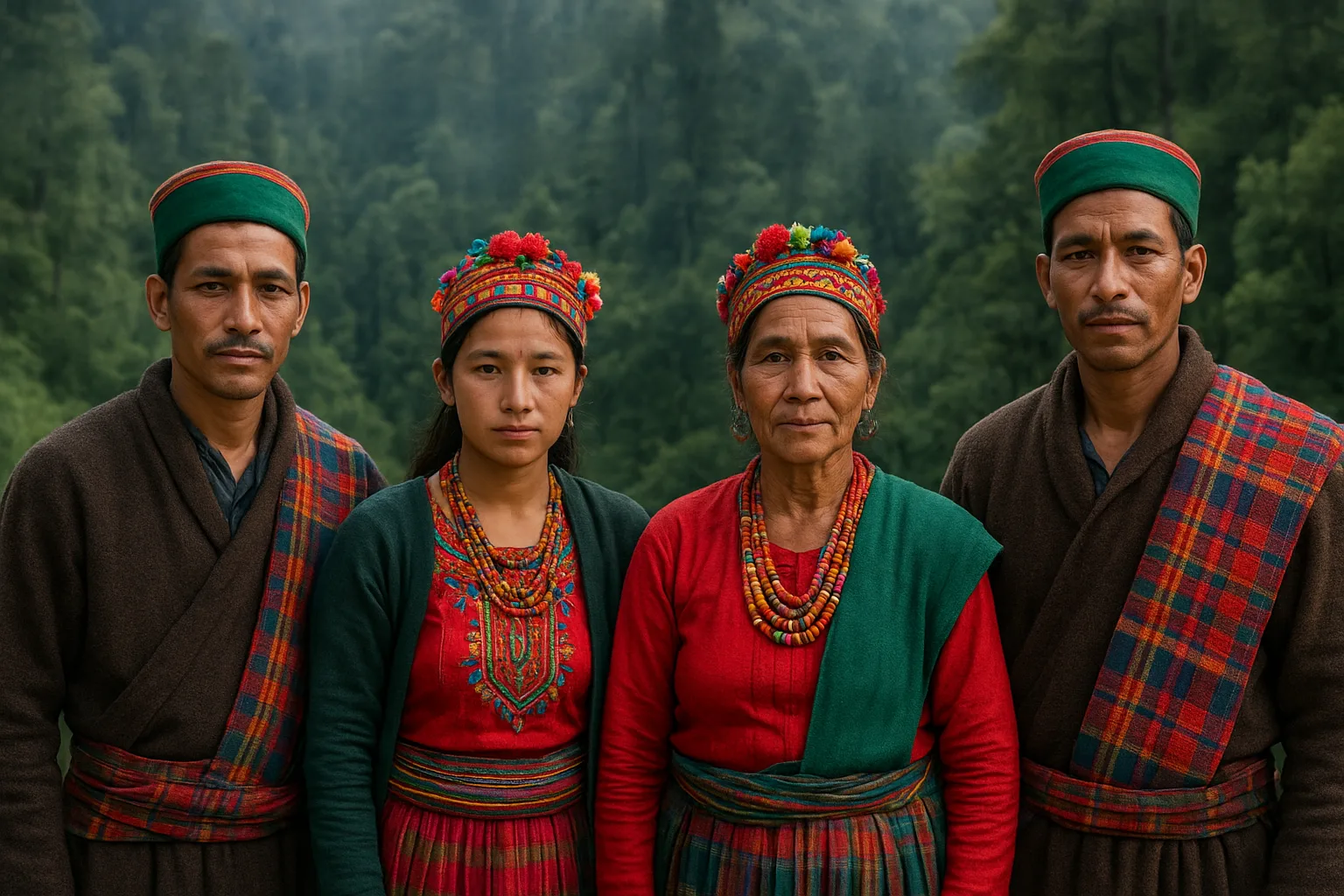
Series: History of Chamba, Himachal Pradesh, India
Phase 1: Ancient Roots — Part 3 of 30
This article is part of a broader historical series exploring the earliest layers of human presence in the western Himalayas. Beginning with landscape, belief, and early patterns of movement and settlement, the series traces how communities adapted to mountainous environments long before formal states or written records emerged. These foundational centuries shaped cultural memory, local traditions, and relationships with the land that would endure through later periods of change.
Shadows on the Ravi: Dawn in the Chamba Highlands
As the sun lifts above the snow-crowned Dhauladhar range, its rays scatter through pine and deodar forests, illuminating the mosaic of valleys that cradle Chamba. For centuries before recorded history, these slopes echoed with the footsteps and voices of early inhabitants—tribal communities whose lives, faiths, and migrations gave Chamba its first distinct shape. In the filtered light of memory and myth, their presence lingers, woven into the roots of the land itself.
Ancient Anchors: Locating Chamba in Deep Time
Archaeological traces in the northwestern Himalayas indicate human activity stretching back to at least the Neolithic era (c. 3000–1000 BCE), though the Chamba basin’s rugged topography has made systematic excavation challenging. The earliest written references to this region appear in the chronicles of neighboring kingdoms and in the oral traditions passed down by its own people. By the close of the first millennium BCE, Chamba’s valleys were already home to settled, organized communities, acting as both crossroads and refuges amid the mountains.
Myth, Memory, and Mountain Lore
The story of Chamba’s origins, as recounted in regional folklore and the Chamba Gazetteer (1883), blends mythic tales with echoes of real migrations. Oral traditions speak of the Khasas—an ancient people believed to have migrated from the northwest, bringing with them unique dialects and customs. These traditions, while colored by legend, reveal a world where tribal clans shaped the land’s earliest political and cultural landscapes. The Khasas are said to have lived alongside or succeeded older indigenous groups, their gods and ancestor spirits still invoked in village rituals today.
The Khasas and the Kol: Tribal Foundations
Historical inference, supported by linguistic and ethnographic clues, suggests the Khasas and Kol were among the most influential early communities in the Chamba region. The Khasas, with roots stretching across the Himalayan arc, were known for their martial prowess and clan-based organization. The Kol, meanwhile, are considered by some traditions to be among the region’s aboriginal inhabitants, connected to the Munda-speaking groups found across central and eastern India.
- Khasas: Predominant in the western Himalayas, their presence is attested in ancient Indian texts and by the persistence of Khasa place names. Their society was decentralized, governed by tribal councils and hereditary chiefs.
- Kol: Often associated with forested uplands, the Kol practiced shifting agriculture, worshipped local spirits, and maintained a deep connection to the land. Though less politically centralized, their imprint on the region’s culture is unmistakable.
These communities, together with smaller groups such as the Gaddis—pastoralists who would later become central to Chamba’s identity—crafted a resilient way of life in the mountains.
Belief Systems and Sacred Geographies
Long before temples of stone rose in Chamba, the landscape itself was sacred. Early tribal faiths centered on animism, ancestor veneration, and the worship of local deities known as deotas. Trees, rivers, and peaks became the abodes of spirits whose favor—or wrath—shaped daily existence. Seasonal festivals and community rituals, some of which survive in modified form, honored these forces. The coming of the Vedic tradition and later Hindu influences would gradually intertwine with, rather than replace, these indigenous beliefs—producing a uniquely syncretic religious culture that still distinguishes Chamba today.
Mountain Trade and Early Settlements
Despite the region’s apparent isolation, Chamba was never a world apart. The Ravi River, slicing through its valleys, linked it to broader Himalayan trade networks. Early settlements clustered along river crossings and highland passes, serving as waystations for traders bearing salt, wool, and grains between Central Asia, Kashmir, and the plains of Punjab. The remains of ancient trails and the strategic positioning of later forts hint at a landscape shaped by both the need for defense and the lure of exchange.
- Key Settlements: Oral history and early chronicles refer to villages like Bharmour—once known as Brahmapura—as centers of tribal power and religious authority. These nuclei would later become the seeds from which Chamba’s first hill states would grow.
From Tribal Confederacies to Emerging Hill States
By the early centuries CE, the gradual consolidation of tribal territories began to yield the first proto-state formations in the region. Local chieftains, often claiming descent from mythic ancestors, negotiated alliances and rivalries across the valleys. These shifting confederacies laid the groundwork for the emergence of the Chamba kingdom under the Rajput rulers—a transition explored in both the Chamba Vamshavali (genealogical chronicles) and colonial-era gazetteers.
Yet even as new political structures arose, the underlying tribal fabric endured. The persistence of clan divisions, customary law, and collective land ownership into the medieval period reveals a deep continuity between these early societies and the world that followed.
Enduring Roots: The Legacy of Chamba’s First Peoples
Walking today through Chamba’s remote hamlets, one still hears Khas and Kol surnames, glimpses traditional wooden shrines, and encounters village councils echoing ancient forms. The rhythms of pastoral migration and the reverence for mountain deities—shaped by those first tribal communities—continue to inform local identity. These early peoples did not vanish; their traditions, stories, and sense of place became the living heart of Chamba’s culture.
As we move forward in this series, we will witness how these tribal foundations both resisted and adapted to the rise of early dynasties, weaving a more complex tapestry of power, faith, and art. The next chapter will guide us into the twilight of myth and the dawn of Chamba’s documented royal lineages.
Previous: Mythological Legends Associated with Chamba
Next: Geography and Isolation in Ancient Chamba