
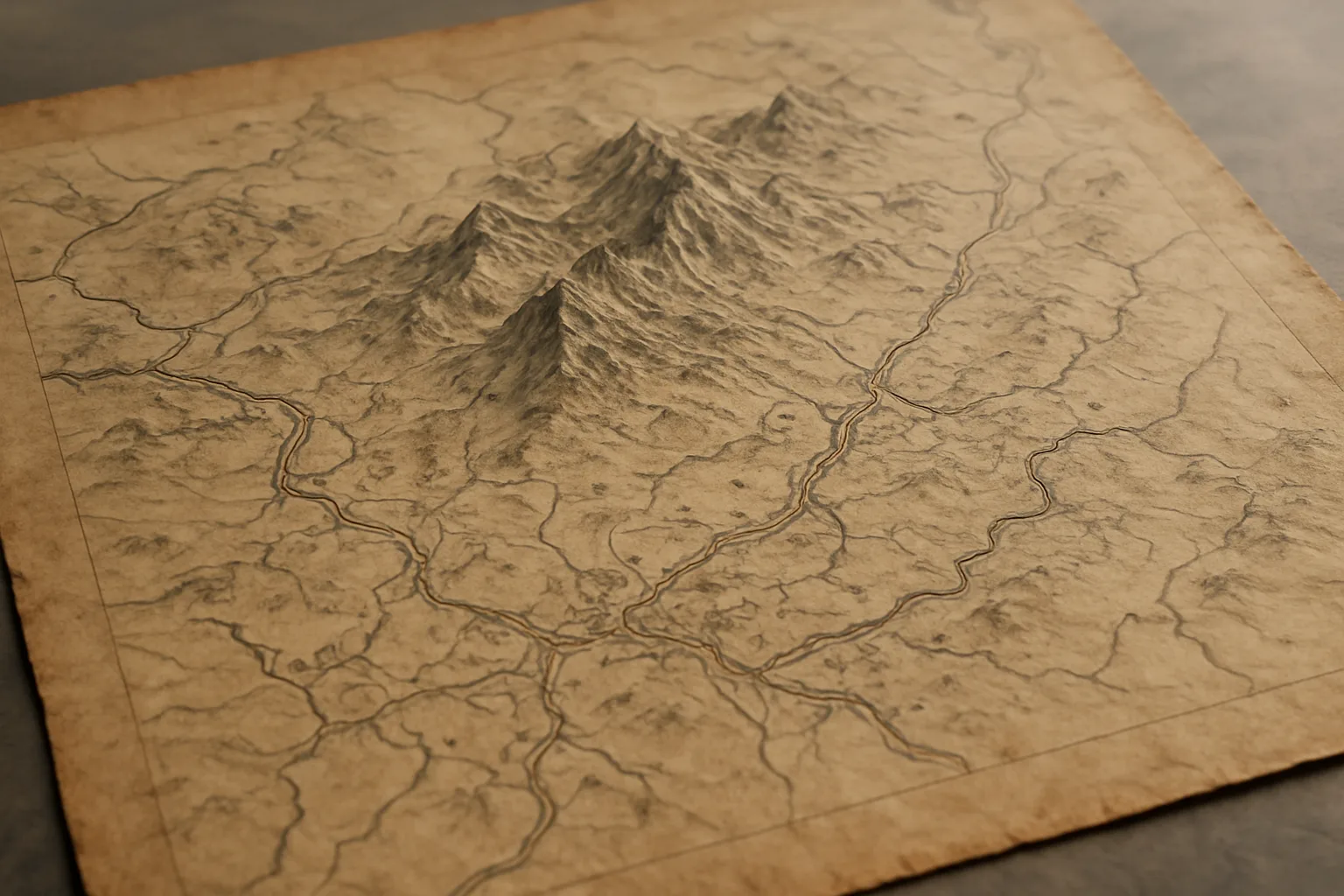
Series: History of Kangra, Himachal Pradesh, India
Phase 1: Ancient Trigarta — Part 1 of 30
This article is part of a broader historical series exploring the earliest layers of human presence in the western Himalayas. Beginning with landscape, belief, and early patterns of movement and settlement, the series traces how communities adapted to mountainous environments long before formal states or written records emerged. These foundational centuries shaped cultural memory, local traditions, and relationships with the land that would endure through later periods of change.
The Forgotten Sunrise Over the Valley
It is dawn in the valley that will one day be called Kangra. The mist clings to the foothills, blurring the line between land and legend. On a ridge above the river, a solitary figure gazes eastward, torchlight flickering on stone—a priest, perhaps, or a chieftain’s sentry. He stands guard not only over his people, but over the memory of centuries. Here, where the land folds into itself in emerald and ochre, history is as dense and layered as the earth beneath his feet.
Ancient Names, Enduring Land
Long before “Kangra” appeared on any map, this region was known to chroniclers as Trigarta—a land of three rivers, fabled in Sanskrit epics and Persian chronicles alike. Kangra, a lesser-known corner of this historic terrain, lay quietly at the intersection of shifting borders, ancient faiths, and merchant routes that linked the Indian heartland to the high Himalayas.
The Mahabharata, one of India’s oldest epics, speaks of the valiant Trigartas, allies of the Kauravas, whose chariots thundered across these valleys. While Kangra itself remained unnamed in these texts, archaeological finds—potsherds, beads, and the outline of vanished walls—suggest that human lives and ambitions pulsed here for millennia. The land remembers what names forget.
In the Shadow of the Chandrabhaga
Geography shaped destiny. The Beas River, known as Chandrabhaga in ancient lore, carved its way past Kangra, providing water, food, and a natural defense. Early settlements clustered along its banks, their mud-brick homes facing the snowbound north. These people—farmers, herders, and artisans—left scant written record, but the rhythm of their lives is encoded in shards and burial mounds seen near Kangra’s modern outskirts.
As trade across the subcontinent intensified, Kangra’s valleys saw the passing of merchants and pilgrims. Gold and salt, wool and grain, and, inevitably, stories flowed through the region. The land’s openness and fertility attracted both settlers and invaders, each leaving a trace—sometimes a coin, sometimes a broken blade, sometimes a legend passed from grandmother to grandchild.
The Rise of the Katoch Dynasty
By the early centuries CE, a new political force began to coalesce in these hills: the Katoch dynasty. Tradition holds that their founder, Susarma Chandra, was a warrior-king who led Trigarta’s armies in the Mahabharata war. Whether myth or memory, the Katochs became the valley’s enduring rulers, their fortresses perched atop crags and their banners fluttering above the forests.
Kangra, nestled in the protective shadow of these powers, benefited from their patronage. Temples rose along riverbanks, their stones etched with prayers in an archaic script. Farmers wrought wheat and barley from the black earth, paying tribute to the Katoch court in Kangra—whose influence reached Kangra’s fields and forests. The dynasty’s chronicles—later written by courtly poets—describe the land’s bounty and its people’s loyalty, even as rival clans eyed the region with envy.
Conflicts and Conquests: The Valley Besieged
Peace in the hills was always fragile. The valley’s riches drew the attention of empires from the north and west. In the 10th century, the armies of Mahmud of Ghazni swept through the Kangra region, their campaigns leaving scars that even time could not erase. While Kangra was spared the worst of the devastation, its people would have seen the smoke rising from distant forts, heard the refugees’ tales, and tightened their village bonds in wary solidarity.
Centuries later, under the shadow of the Delhi Sultanate and then the Mughals, the Katoch kings became vassals, rebels, or survivors—depending on the year. Kangra’s strategic position, on the edges of the main trade routes but close enough to the centers of power, made it a place of refuge for some, ambition for others. Local legends still speak of hidden treasures and secret tunnels, relics of an age when danger was always at the threshold.
Faith and Everyday Life in Ancient Kangra
Yet through these tumultuous centuries, the rhythms of daily life in Kangra rarely ceased. Villagers gathered at dawn to worship at stone shrines dedicated to Shiva and Devi, their prayers echoing across the fields. The cycle of planting and harvest, of birth and remembrance, went on. The region’s oral traditions, preserved in song and dance, recall both the fear of marauding armies and the beauty of monsoon rains.
Festivals marked the turning of the seasons. In spring, bright colors and music filled the valley in honor of Holi. Autumn brought processions for Navaratri. Through it all, local families—descendants of those ancient Trigartas—found meaning and resilience in shared ritual. The hills shielded them from much, but the world’s turbulence always seeped in, shaping how they saw themselves and their place in the broader story of India.
Kangra’s Legacy: Memory in the Modern Era
The echoes of ancient Trigarta, of Katoch kings and wandering traders, still linger in Kangra’s landscape. Today, the valley sits quietly, its fields greener than ever, its villages a patchwork of old and new. Schoolchildren walk paths that once bore the footprints of chieftains and travelers. Elderly storytellers recall, with a spark in their eyes, the days when every hill had a guardian spirit and every stone a story.
Kangra’s history is not merely a tale of kingdoms and conquests—it is a chronicle of endurance, adaptation, and the subtle connections between past and present. As the world changes around it, the valley’s ancient identity continues to shape its people: proud of their roots, aware of their role in a much larger tapestry, and ready, always, to remember.
Next: Kangra in Vedic and Epic Literature