
Series: Bilaspur Himachal History
Phase 4: British & Post-Independence — Part 19 of 29
The Dawn Whistle: A Town Awakes
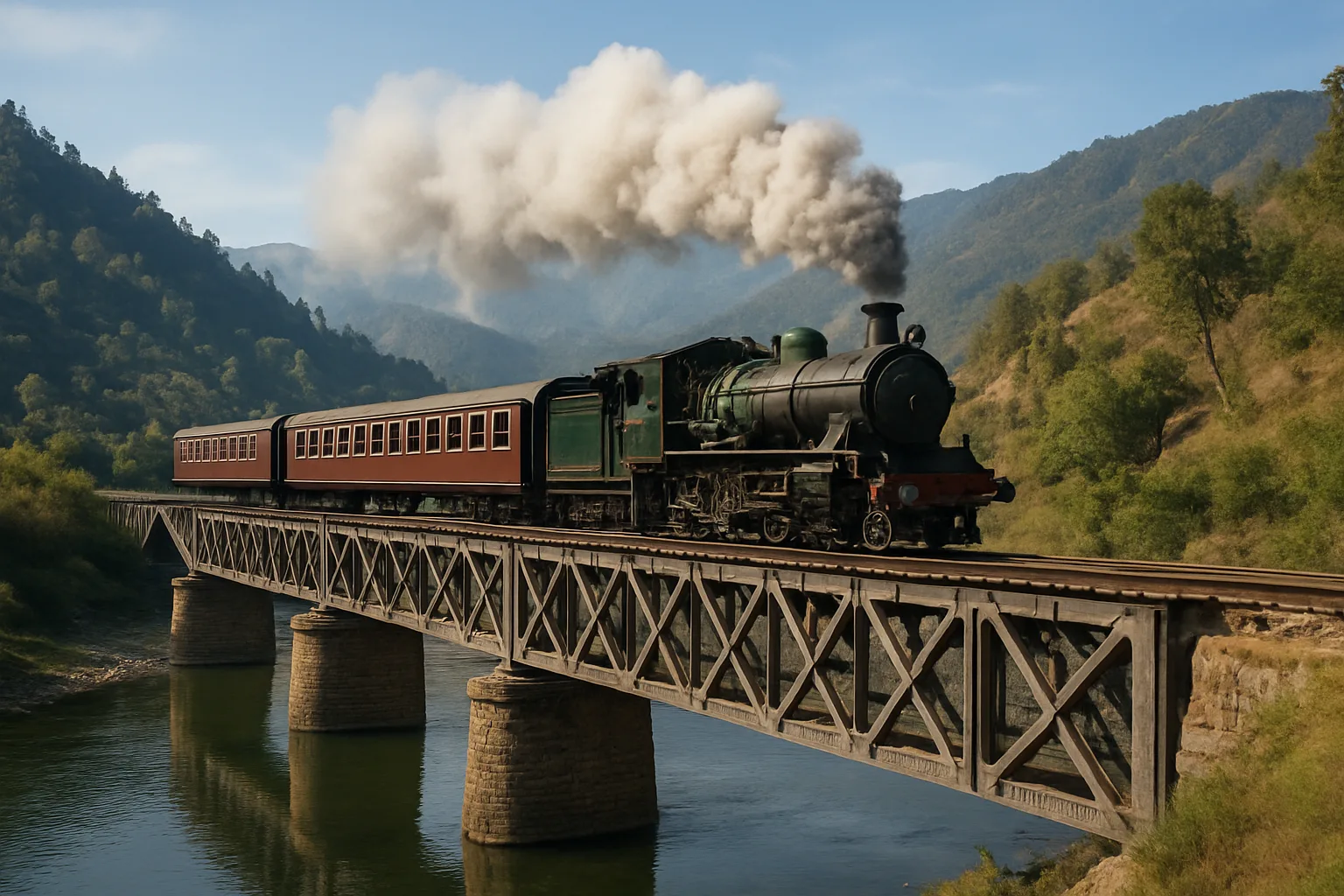
In the early hours of a February morning in 1922, the people of Bilaspur awoke to an unfamiliar sound—a distant, rhythmic chuff, punctuated by the shrill call of a steam locomotive. The railway had arrived, its iron tracks slicing through the sleepy valleys and ancient ridges of Himachal Pradesh. For the first time, the world beyond the hills seemed closer, and the lives of Bilaspur’s people stood on the verge of irreversible change.
Bilaspur Before the Tracks
For centuries, Bilaspur stood as a princely state nestled along the banks of the Sutlej River, ruled by the Chandel Rajputs whose lineage traced back to the 7th century. The town’s bazaars bustled with local traders, while the palatial Nalagarh and the revered Naina Devi temple watched over the people. Life moved at the slow pace of the river, governed by rhythms of harvest and festival, largely undisturbed by the world beyond the Shivaliks.
Yet, the British Raj’s gaze was ever-expanding. By the late 19th century, their ambitions had reached even the remote hills of Bilaspur, spurred by both strategic concerns and the allure of natural resources. The railway was to be the spearhead—a physical and symbolic assertion of control, promising prosperity but threatening the old order.
Iron Ambitions: Enter the British Engineers
The key figure in Bilaspur’s railway saga was Sir Guilford Molesworth, Chief Consulting Engineer of the India Office. In 1919, he led the survey teams that mapped possible routes through the challenging terrain. The project was daunting: landslides, dense forests, unpredictable rivers, and the ever-present risk of monsoon floods. Still, British resolve—and capital—was unwavering. The rail line, intended to connect Kalka to the Punjab plains, would skirt Bilaspur, forever altering its destiny.
Local rulers, notably Raja Bijai Chand, initially viewed the project with skepticism. While British officials promised economic uplift and modernity, the Raja sensed the erosion of his autonomy. Yet, resistance was stifled by deft negotiation and the overwhelming momentum of the Empire. By 1920, the first railway camps dotted the outskirts of Bilaspur, bringing with them not just engineers, but a tide of migrant laborers, traders, and new customs.
Tracks of Transformation
The railway’s construction was a spectacle—an army of workers wielding picks and dynamite, carving tunnels and erecting bridges where goats once grazed. The air filled with the clang of iron and shouts in half a dozen languages. For Bilaspur’s residents, the arrival of the railway meant more than a new mode of travel. It was a portal to the wider world: exotic goods began to appear in the markets, and young men left for jobs in distant towns, returning with stories of bustling cities and new ideas.
But the transformation was not without cost. Traditional livelihoods, especially those tied to riverine trade, suffered as the railway diverted traffic and commerce. The forests thinned to fuel steam engines, and the landscape itself seemed to shift, reshaped by the relentless drive of progress. The social fabric frayed in places, as old hierarchies were challenged by the influx of outsiders and the new economy.
Unrest and Awakening
Bilaspur’s encounter with the British railway was not merely a story of technological change. It became a crucible for political awakening. Inspired by the wider Indian independence movement and stoked by grievances over land acquisition and labor conditions, pockets of resistance emerged. In 1930, as Mahatma Gandhi’s Salt March reverberated across India, Bilaspur’s students and workers organized strikes and protests, demanding fair wages and greater say in their own affairs.
The British response was predictably swift—arrests, curfews, and a tightening of administrative grip. Yet, the seeds of dissent had been sown. Figures like Pandit Sohan Lal and Babu Ram Joshi, educated in the new schools the British had set up, began to articulate a vision of self-rule that drew on both local tradition and modern ideals. The railway, paradoxically, became both a symbol of colonial power and a conduit for revolutionary thought.
The Shadow of Partition
As the 1940s dawned, the rumble of trains through Bilaspur’s hills carried a different cargo—refugees, rumors, and uncertainty. The approach of independence and the trauma of Partition in 1947 cast long shadows. Bilaspur, once a quiet princely state, now found itself a waypoint for those fleeing violence in the Punjab, its railway station crowded with desperate families and anxious officials.
Raja Anand Chand, the last ruling monarch, played a delicate role: negotiating with both departing British officials and the new Indian authorities. In 1948, Bilaspur acceded to the Indian Union, and the railway—once a mark of foreign control—became a lifeline for a state rebuilding itself amid national upheaval.
Remaking the Land: The Bhakra Dam Era
Just as Bilaspur’s people began to find their footing in independent India, another monumental project arrived: the Bhakra Dam. The world’s highest gravity dam, begun in 1948, promised electricity and prosperity for the new nation. But for Bilaspur, it meant sacrifice: the old town, with its palaces and memories, was submerged under the dam’s reservoir by the late 1950s.
The railway once again played a central role, ferrying materials and workers for the dam’s construction, as well as aiding the resettlement of thousands displaced by the rising waters. Old Bilaspur vanished beneath Govind Sagar Lake, but its spirit endured in the new township that rose on higher ground—its bazaars, temples, and railway station surviving in altered form.
Legacy of Iron and Water
Today, Bilaspur’s railway heritage is woven into the rhythms of daily life. The tracks still echo with the sounds of passing trains, while the Naina Devi temple and the Bhakra Dam draw pilgrims and tourists alike. The transformations wrought by the railway—economic, social, and political—continue to shape the town’s identity.
Bilaspur’s story is one of adaptation, resilience, and reinvention. The iron rails that once threatened to erase its traditions became, in time, the very means by which its people connected to the wider world and to each other. The shadow of the railway still falls across Bilaspur’s hills, a reminder of the costs and possibilities of progress.
In the faces of Bilaspur’s new generation, one can glimpse both the scars and the hopes born of this long encounter with British engineering. The past continues to ripple through the present, shaping the town’s ambitions, its anxieties, and its enduring sense of place.
Previous: Hidden Administrative Reforms in Colonial Bilaspur
Next: Bilaspur’s Quiet Role in India’s Freedom Struggle