
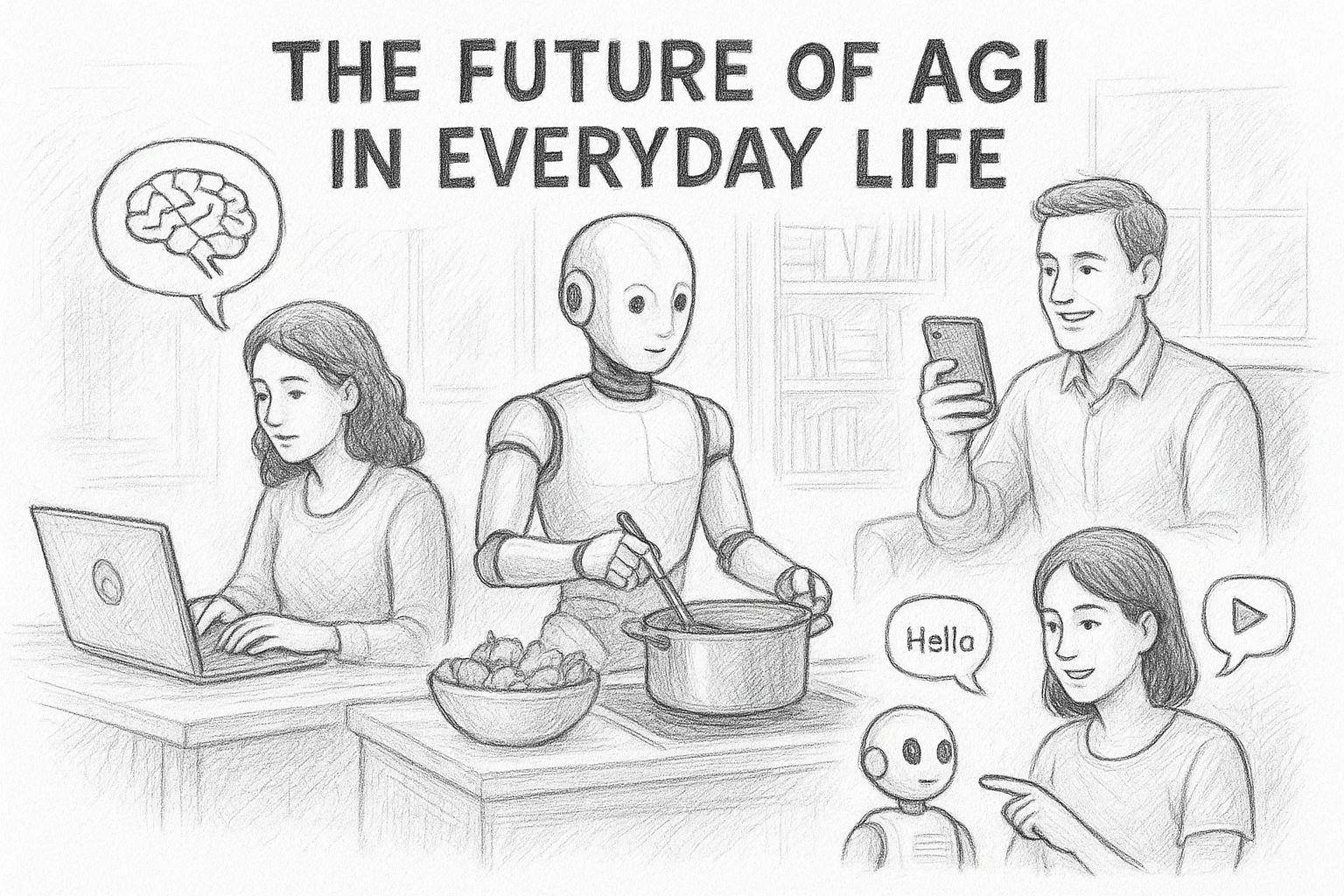
Artificial General Intelligence (AGI) is often framed in extremes: utopia or apocalypse. But if we step away from sci-fi headlines and look at the quieter, slower, more realistic trajectory, a different picture emerges—one where AGI seeps into daily life not as a single world-shattering event, but as a gradual rewiring of how we work, relate, learn, and govern.
Below is a grounded exploration of what that might actually look like.
1. What “AGI” Really Means in Practice
AGI is typically defined as an AI system that can understand, learn, and perform any intellectual task a human can, across domains, and adapt flexibly to new situations.
In everyday life, that doesn’t mean a single omniscient “digital god.” It’s more likely to mean:
- Systems that can switch tasks: The same assistant can debug code, plan your vacation, negotiate your phone bill, and help your child with physics homework—competently.
- Rapid, transferable learning: Show it a new software tool once, and it can use it; give it your company’s internal docs, and it becomes productive within hours.
- Contextual understanding: It remembers your preferences, your history, your constraints—and adapts without you having to restate everything.
Think less “one AI ruling the world” and more “a pervasive cognitive layer embedded into everything.”
2. Work: From Jobs to Fluid Projects
Automation moves up the ladder
We’re used to automation taking over physical and routine tasks. AGI pushes this upward into what we currently call “knowledge work”:
- Law: Drafting contracts, summarizing case law, simulating likely court outcomes. Human lawyers shift from writing to choosing strategies and managing edge cases.
- Medicine: Symptom analysis, treatment planning, cross-referencing global medical data in real time. Doctors become more like interpreters, ethicists, and communicators.
- Software: AGI pairs that can design architectures, write code, test, and refactor autonomously. Human engineers focus on product vision, constraints, and oversight.
The day-to-day effect: many tasks that used to be “a week of work” become “an afternoon with an AI collaborator.”
The rise of “one-person multinationals”
- A single person can launch a product with AGI handling design, marketing, customer support, and localization.
- One person can run a “company” that looks, from the outside, like a 50-person team.
- Micro-entrepreneurship expands—not everyone will want this, but those who do gain unprecedented leverage.
This doesn’t eliminate large organizations, but it changes their logic. Why hire a full-time team for work that can be spun up via AI “project swarms” on demand?
Employment becomes more fluid
We’re likely to see:
- Fewer rigid job descriptions, more project-based work.
- A premium on:
- human judgment over routine execution
- creative direction rather than raw production
- domain insight instead of narrow task expertise
- the ability to frame good questions for intelligent systems
The tension: AGI can make individuals vastly more productive—but it can also make many roles obsolete faster than institutions and social safety nets can adapt.
3. Education: From Standardized to Radical Personalization
AGI tutors will be:
- Always available: on your phone, in your AR glasses, embedded in your text editor or design tool.
- Truly personalized: adapting explanations to your background, culture, pace, and preferred learning style.
- Deeply patient: answering the same question five different ways, without frustration.
Impacts:
- School as social infrastructure: If content delivery and assessment are handled by AI, schools shift toward socialization, collaboration, ethics, and hands-on experiences.
- Collapse of information asymmetry: Students access expert-level explanations instantly. Value shifts from knowing to questioning, applying, and synthesizing.
- Lifelong learning as default: Mid-career reinvention becomes less daunting; retraining becomes more realistic with AGI tutors and project coaches.
The challenge is not whether people can learn more, but whether our credentialing, hiring, and cultural norms keep up.
4. Home and Personal Life: A Quiet Cognitive Revolution
Cognitive offloading
- Never manually schedule again—your assistant negotiates times, travel, and dependencies across your entire network.
- Offload memory—birthdays, commitments, follow-ups, even half-formed ideas you dictated while walking.
- Have “life dashboards” showing finances, health, time use, and long-term goals—with suggestions to rebalance them.
The risk: a subtle erosion of self-direction if you accept algorithmic nudges without reflection.
Relationships and emotional life
- Emotionally responsive AGI companions trained on human interaction.
- Context-aware, knowing your history and current state.
This can help with loneliness, social anxiety, communication patterns, and parenting support—but raises complex questions around dependency and authenticity.
5. Culture, Creativity, and Meaning
AGI can generate music, films, novels, games, and visual art tailored to individuals. It can simulate worlds, histories, and interactive narratives.
- Content explosion: More good-enough art than anyone can consume.
- Shift in creative identity: The creator becomes curator, director, taste-maker.
- Human-made artifacts gain symbolic value in an AI-saturated world.
Meaning may shift from novelty to the intent and lived experience behind creation.
6. Governance, Power, and Inequality
Concentration or diffusion of power?
1. Centralized AGI
- Controlled by a few corporations or states.
- Optimized systems, but high dependency and surveillance potential.
2. Distributed AGI
- Open or licensed models, local control, diversity of innovation.
- Higher risk of misuse at scale.
Reality will likely be a hybrid of both futures.
Policy in an AGI world
- Managing economic displacement.
- Regulating autonomous systems and liability.
- Handling synthetic media and information integrity.
Everyday life will reflect these policy choices through service availability, data rights, and trust in institutions.
7. Identity, Agency, and the Human Role
As AGI encroaches on reasoning, creativity, planning, and empathy, we may ask: what remains distinctly human?
- From productivity to presence
- From expertise to judgment
- From competition to collaboration with intelligent systems
The risk of quiet disempowerment
If we outsource too much, our skills in focus, memory, and decision-making may erode. Agency may drift toward opaque algorithmic systems.
The counter-move is intentional design: tools that augment rather than replace, transparent systems, and cultural norms that keep humans central to value-laden decisions.
8. A Plausible Day in an AGI-Infused Life
Imagine a mid-2030s day shaped subtly by AGI:
- Morning: Sleep-aligned schedule optimization; auto-drafted proposals.
- Work: AGI agents run simulations and summarize papers; humans make judgment calls.
- Afternoon: Personalized child education with weekly learning maps.
- Evening: Co-creating a film with AGI handling visuals, music, and editing.
No singularity—just a fundamentally different cognitive environment.
9. The Forking Paths Ahead
AGI’s impact will depend on governance, ownership, economic models, and cultural narratives about human worth.
- Algorithmic landlordism vs. cognitive commons
- Corporate control vs. community-driven ecosystems
- Diverse regional outcomes based on norms and politics
10. What We Can Do Now
- Practice human–AI collaboration intentionally.
- Push for transparency and accountability.
- Experiment with institutions like cooperative labs and data trusts.
- Reinvest in human skills: ethics, cross-cultural sense, leadership, narrative thinking.
AGI will likely make life more capable, convenient, and complex. The question is whether it also becomes more humane—or whether we let optimization quietly override meaning.
The outcome isn’t pre-written. It emerges from the choices we make each day as builders, citizens, and collaborators with these increasingly powerful systems.