
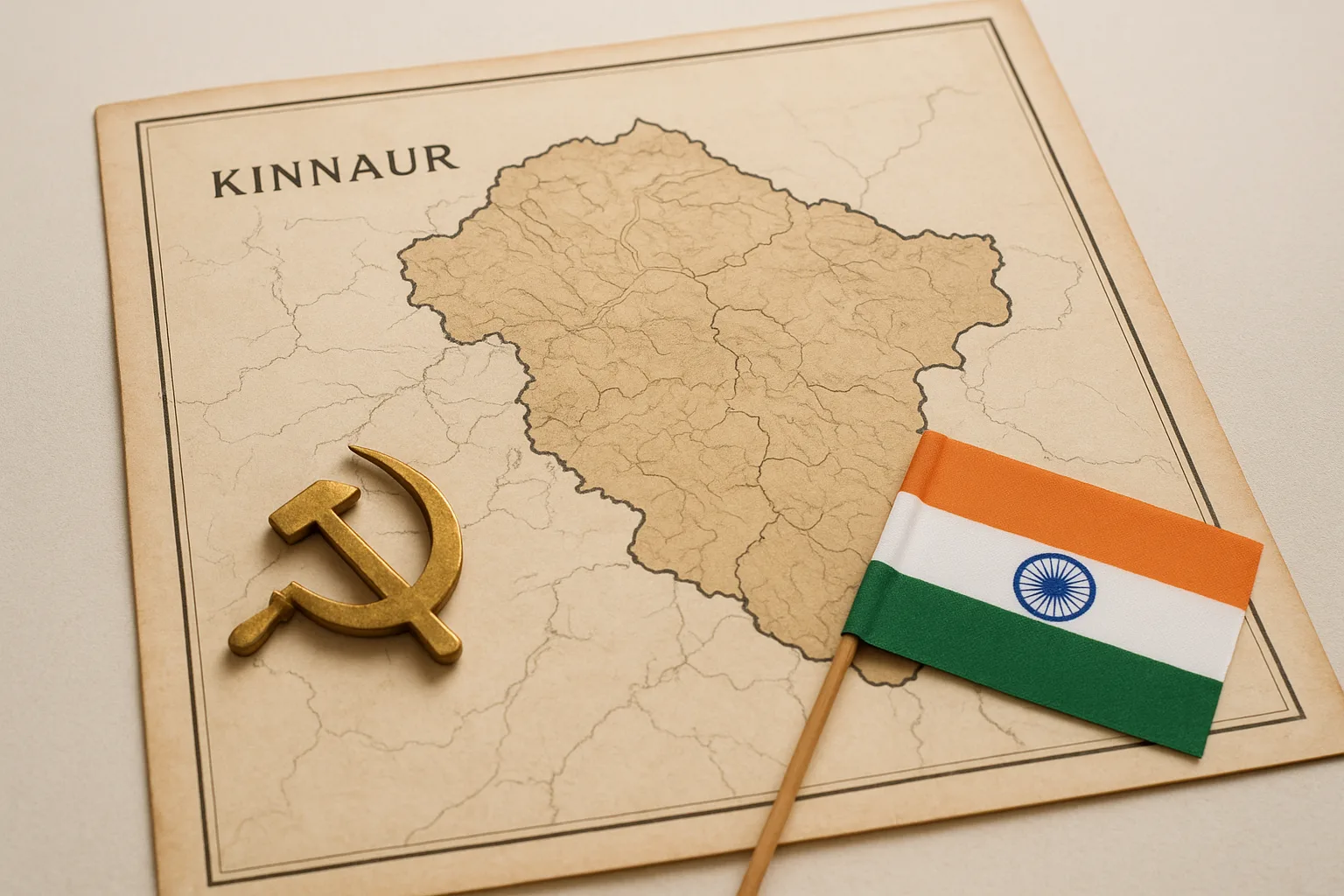
Series: History of Kinnaur, Himachal Pradesh, India
Phase 5: Modern Era — Part 21 of 30
This article appears within a continuing historical series that follows the western Himalayas into the modern era. With the end of princely rule and the integration into independent India, long-standing social and political patterns were reconfigured. This phase examines how development, state formation, and memory interact with inherited landscapes, shaping contemporary life while carrying forward echoes of the past.
Dawn in the Sutlej Valley, 1947
At sunrise, the Sutlej carves through a land still untouched by the turbulence shaking the plains below. In the high villages of Kinnaur, daily rhythms—prayers to local deities, the clang of blacksmiths, the distant calls of shepherds—persist much as they have for centuries. Yet, in late summer of 1947, subtle ripples run through these valleys. Rumors trickle in: British rule has ended, and a new nation is being born. For Kinnaur’s people, perched between the Himalaya and the frontier of empire, this is both distant news and the harbinger of profound change.
An Enigmatic Land at the Edge of Empires
Kinnaur’s recorded history is a tapestry woven from oral tradition, myth, and the careful notations of colonial administrators. Myths speak of the region as the home of the Kinners—celestial musicians in Hindu lore—while local ballads recall migrations from Tibet and the ancient kingdom of Bushahr. Gazeteers from the late nineteenth century depict Kinnaur as a remote, semi-autonomous tract, its valleys linked more closely to Central Asia and western Tibet than to the plains of India. For centuries, Kinnaur was a borderland: a crossroads of Buddhist and Hindu beliefs, of ancient trade routes carrying salt, wool, and turquoise across mountain passes.
Communities and Settlements Before Independence
By the early twentieth century, Kinnaur’s society was a mosaic of language, custom, and caste. The Kinnauras, with their unique dialects and syncretic faiths, formed the majority. Picturesque villages like Kalpa, Nichar, and Sangla perched on terraced slopes, each with its own intricate wooden temple and oral histories stretching back generations. The Rajput and Scheduled Caste communities lived alongside each other, bound by tradition but divided by custom. Buddhism and Hinduism merged in local practice: village gods (devtas) shared space with Buddhist chortens and monastic traditions, reflecting centuries of cultural exchange.
Hill States and Colonial Presence
Before 1947, most of Kinnaur fell under the rule of the Bushahr state, one of the largest hill principalities in the western Himalaya. The Bushahr rajas, claiming descent from ancient Kshatriya lines, governed from their winter capital at Rampur. Their authority in Kinnaur was at times tenuous—local councils and village elders often settled disputes, while the raja’s tax collectors visited only periodically. British colonial officials, arriving in the mid-1800s after the Anglo-Gurkha wars, imposed a light administrative touch. They mapped trade routes, registered land, and collected revenue, but rarely intervened in the rhythms of village life.
Trade and Transformation
For centuries, Kinnaur’s lifeblood was trade. Caravans of yaks and mules crossed the Shipki La and other passes, exchanging Himalayan salt, wool, borax, and dried apricots for grains and cloth from the south. This commerce shaped local identities and kept Kinnaur connected to distant markets in Tibet and Central Asia. But by the 1940s, these routes were fraying: the British had tightened borders, and the Second World War brought new restrictions. Change was in the air, even before the upheaval of independence.
The Tumultuous Winds of 1947
As the subcontinent prepared to throw off colonial rule, Kinnaur watched from afar. The region’s remoteness sheltered it from the violence of Partition, but not from the uncertainties of transition. News arrived slowly, filtered through traders and officials in Rampur and Simla. In the months after August 15th, 1947, the old order lingered: Bushahr’s raja remained in place, and British officers gradually withdrew.
Yet, the idea of India—new, democratic, inclusive—began to take root. Local leaders, inspired by the independence movement, started to imagine a future beyond princely rule. Village councils debated their place in the new republic, weighing the risks and opportunities of integration. Would ancient rights be protected? Could local customs survive the coming wave of modernization?
Negotiating the New Nation
In the years immediately following independence, the Indian government faced the daunting task of integrating hundreds of princely states. For Bushahr, and thus for Kinnaur, the process was cautious but inevitable. In 1948, Bushahr acceded to the Indian Union, joining a new administrative unit called the Himachal Pradesh province. Kinnaur, still isolated by geography and winter snows, now found itself tethered to the aspirations of a rapidly modernizing nation.
The transition was not always smooth. Local fears of losing cultural autonomy were real. Many remembered how colonial administrators once dismissed Kinnauri customs as backward, and they worried that distant bureaucrats might do the same. Yet, for the first time, there were also prospects: roads, schools, and new connections to the outside world.
Promises and Pressures of Integration
The 1950s and 1960s brought profound transformation. The Indian state, eager to secure its Himalayan frontiers after the 1962 Sino-Indian War, invested heavily in road-building and infrastructure. The old mule tracks gave way to motor roads snaking up the Sutlej, forever altering the rhythms of life. New administrative frameworks replaced princely rule, with local representatives now sent to the Himachal Pradesh Assembly. Literacy rates began to climb, and the first stirrings of political activism reached even the highest villages.
Yet, the pace of change brought new tensions. Traditional authority—village gods, elders, and customary councils—sometimes clashed with modern laws and officials. Land reforms challenged old hierarchies, and the arrival of outsiders threatened the fragile balance of culture and environment. Oral traditions, once the backbone of collective memory, now competed with textbooks and government directives.
Resilience and Adaptation
Despite upheaval, Kinnaur’s communities adapted with remarkable resilience. The devtas—village deities—remained central to local identity, their festivals and processions undiminished by modernity. Women’s roles, long constrained by custom, began to shift as education spread. The Kinnauri language, once confined to home and hearth, found new champions among a rising generation of poets and activists.
Kinnaur Today: Echoes of the Past
More than seventy years since independence, Kinnaur stands transformed but not unmoored from its past. The scars of Partition never touched these valleys, but the legacy of integration runs deep: in the schools that dot the hillsides, in the roads that link remote hamlets to Rampur and beyond, in the delicate interplay of tradition and change. Local identity remains fiercely protected—the devtas are still consulted in village affairs, and the rhythms of the agricultural calendar persist.
Yet, the world presses closer every year. Tourism, hydroelectric dams, and climate change bring new challenges, testing the old ways of life. The story of Kinnaur’s integration into India is not just one of loss or adaptation, but of creative endurance—a testament to how a borderland people have navigated the tides of history, holding fast to what matters most.
Looking Ahead
The journey is far from over. In the next part of this series, we will trace how Kinnaur’s unique voices have shaped—and sometimes contested—development, politics, and cultural revival in the decades since independence. The echoes of the past still guide the future, as Kinnaur continues its story at the edge of the Himalaya, within the embrace of a changing India.
Previous: End of Princely and Colonial Control in Kinnaur
Next: Designation of Kinnaur as a Tribal District