
Series: History of Kinnaur, Himachal Pradesh, India
Phase 4: British Period — Part 18 of 30
This article is part of a wider series tracing the transformation of the western Himalayas under colonial influence. As British authority extended into the hills, existing political systems were restructured through treaties, administration, and new forms of governance. This phase considers how colonial rule reshaped society, economy, and space while leaving lasting imprints on local identity.
Winter in Kinnaur, 1850: Shadows and Snowfall
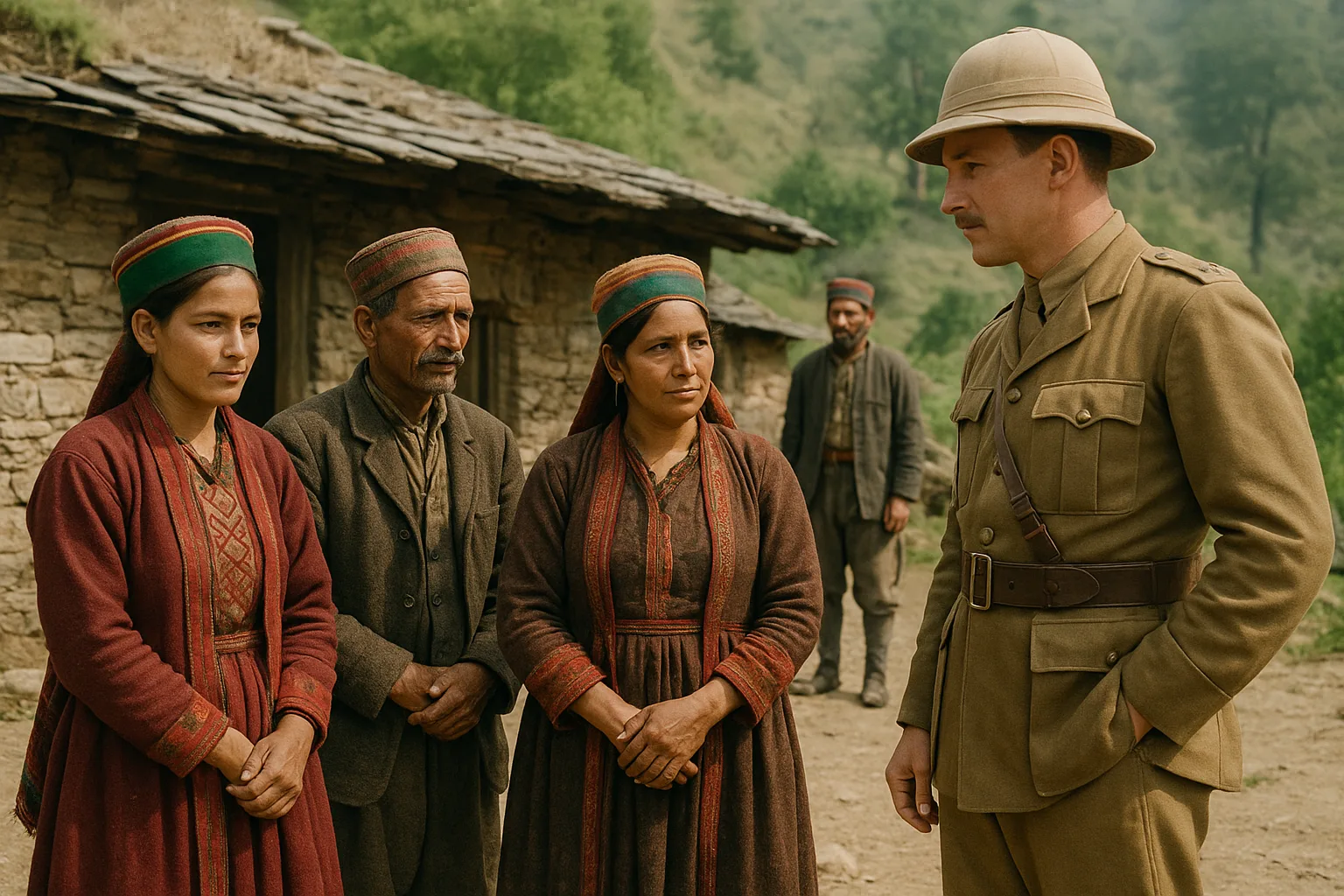
Night falls early in the deep valleys of Kinnaur. Under the hush of Himalayan snow, a cluster of stone houses glows with pinewood firelight. Inside, elders recount legends of ancestors who crossed high passes, while young ones listen, eyes wide, to stories as old as the mountains themselves. Outside, the wind carries hints of change. It is the middle of the 19th century, and the world beyond these ridges has shifted. British officials—strangers with unfamiliar languages and customs—have begun to trace the winding river valleys, mapping, measuring, and quietly reshaping the lives of Kinnaur’s tribal communities.
Ancient Roots: The Kinnaura and Their Land
Long before colonial borders, Kinnaur was a land of diverse tribal communities. The Kinnaura people, whose ancestry blends Indo-Aryan and Tibeto-Burman roots, had cultivated this rugged landscape for centuries. Oral traditions—preserved in songs, ritual chants, and winter gatherings—spoke of mythic ancestors, of a land gifted by gods and guarded by local deities, the devtas.
Yet beneath the poetry of myth, historical inference suggests that Kinnaur’s early settlements emerged along riverbanks and trade routes linking India and Tibet. These routes, vital arteries for salt, wool, grain, and turquoise, brought not just goods but new ideas and faiths. For generations, Kinnauris maintained a delicate balance between their animist beliefs and the growing influence of Buddhism and Hinduism, visible in their temples and the stories passed down through families.
The Coming of Colonial Boundaries
It was not until the early 19th century that Kinnaur entered the British imagination. The collapse of the Gurkha power in the western Himalayas during the Anglo-Nepalese War (1814–1816) opened these valleys to British surveyors and administrators. The 1815 Treaty of Sugauli extended British influence to the Sutlej, and with it, Kinnaur—long a borderland—found itself within the growing map of the British Raj.
From this point, documented political history becomes clearer. The British, wary of the region’s challenging terrain and its proximity to Tibet, left much of local administration in the hands of traditional village headmen (gaon buras) and the rajas of the emergent hill states. Yet even indirect rule was transformative. The Revenue Settlement of 1846, detailed in the early gazetteers, formalized land rights and imposed new taxation systems—an unfamiliar and often resented intrusion into long-standing communal practices.
Everyday Life Under Colonial Gaze
For Kinnaur’s tribal communities, daily rhythms centered on the land: tending barley fields, herding sheep and goats, and maintaining sacred groves. Festivals and rituals, such as the Phulaich flower festival, marked the turning of the seasons and reaffirmed kinship bonds. The British presence, though distant in the physical sense, gradually seeped into these patterns.
British officers, traveling with retinues and survey instruments, recorded local customs with a mix of curiosity and condescension. Early accounts in the administrative records describe the Kinnaura as industrious yet “primitive”—a term reflecting colonial bias rather than lived reality. These observations filtered into policies that sought to catalogue, classify, and sometimes ‘improve’ tribal life, often failing to grasp the deep logic of indigenous customs.
Belief, Law, and Governance: A Tenuous Balance
One of the most profound changes came in the realm of governance. The British introduced new legal codes, often at odds with local customary law. Disputes over land, marriage, or forest rights—once settled by village councils or under the watchful eye of the devta—now moved to colonial courts in Rampur or Shimla. This shift unsettled older systems of authority, yet many communities persisted in their traditions, meeting quietly after dusk to resolve matters their own way.
The region’s hill states—Bushahr chief among them—navigated a careful path. Their rulers, the Bushahr rajas, entered into subsidiary alliances with the British, preserving a measure of autonomy in exchange for loyalty and tribute. For ordinary Kinnauris, these arrangements were remote, yet their effects rippled down through tax collectors, forest guards, and the changing terms of access to pasture and timber.
Trade Routes and the Ties That Bind
Despite the disruptions, the enduring pulse of Kinnaur’s trade routes remained. Caravans still creaked over the Shipki La and other high passes, linking Kinnaur with Tibet and the plains. Wool, salt, and dried apricots flowed down to Rampur’s bustling markets, even as British officials attempted to regulate and tax these exchanges more tightly.
Yet, the shadow of the British Empire brought new anxieties. Fears of Russian advances in Central Asia prompted the Raj to restrict cross-border movement, especially after the 1870s. The once-open borderlands began to harden, straining the old networks of kinship and commerce that had bound Kinnaur to its neighbors for generations.
Memory and Resilience: Oral Traditions Endure
Throughout these decades, oral traditions became a quiet form of resistance and continuity. Elders wove the memory of pre-British times into their tales, preserving the dignity of their forebears and the wisdom of the land. Even as schools introduced by the British taught new alphabets and histories, the stories of the devtas and ancestral migrations persisted—an unbroken thread connecting the present to a mythic, yet deeply felt, past.
Echoes into the Present
To walk through Kinnaur today is to feel the layers of this history underfoot. The architecture of its temples, the rhythms of its festivals, and the tenacity of its customs all bear witness to a people who adapted, endured, and found ways to bend the weight of colonial rule without breaking their identity. The British chapter left scars and new structures, but Kinnaur’s ancient roots—nourished by memory, ritual, and the land itself—continue to shape its future.
The next post in this series will explore how these colonial transformations laid the groundwork for social and political awakening in Kinnaur as the 20th century dawned, setting the stage for new forms of resistance and renewal.
Previous: Colonial Administration and Border Policies in Kinnaur
Next: Restricted Access and Isolation During the Colonial Era