
Series: History of Kangra, Himachal Pradesh, India
Phase 5: Modern Era — Part 28 of 30
This article appears within a continuing historical series that follows the western Himalayas into the modern era. With the end of princely rule and the integration into independent India, long-standing social and political patterns were reconfigured. This phase examines how development, state formation, and memory interact with inherited landscapes, shaping contemporary life while carrying forward echoes of the past.
Before the Morning Mist: Kangra Fort Awakes
As the first light crests the Dhauladhar, a chill clings to the ancient stones of Kangra Fort. From its ramparts, the Beas River glitters in the distance, winding through a landscape that has cradled belief, ambition, and resilience for over a millennium. This place is more than a relic; it is the living heart of a region whose history is layered, contested, and fiercely protected.
Stone and Story: The Roots of Kangra’s Heritage
The valley below the fort once echoed with the footsteps of early settlers. Oral traditions—passed down in Kangri dialect and folk song—speak of Raja Bhumi Chand, the legendary founder of the Katoch dynasty, who is said to have built the first fortifications here. While mythology clings tightly to these origins, historical inference suggests that the region’s strategic position along early Himalayan trade routes fostered a patchwork of thriving hill settlements as early as the first millennium BCE.
Ancient temples—such as the revered Jawala Ji and Brijeshwari Devi shrines—emerged as both spiritual anchors and centers of local administration. Their architecture, stone reliefs, and copper inscriptions reveal a blend of Pahari artistry and evolving belief systems. Here, goddess cults, Shaivite asceticism, and later Vaishnavite influences converged, giving Kangra a spiritual reputation that persists even today. The fort and temples were not isolated sites: they were vital nodes in the networks of pilgrimage, trade, and politics that bound the lower Himalayas together.
Chronicles of Power: The Fort in Medieval Memory
Written records—like the Persian “Tarikh-i-Kangra” and regional gazetteers from the colonial era—offer glimpses into the fort’s changing fortunes. By the time of Mahmud of Ghazni’s infamous raid in 1009 CE, Kangra had become synonymous with immense temple wealth and hill-state autonomy. Chroniclers describe how waves of invaders, from Turks to Mughals and Sikhs, coveted the valley’s riches. Each conquest left scars upon the stone: shattered idols, scorched gates, rebuilt ramparts.
Yet, the fort rarely fell for long. The Katoch rulers, drawing upon intricate ties with local chieftains and Brahminical elites, orchestrated cycles of resistance and renewal. Their patronage ensured that temples—flattened by war or earthquake—were painstakingly restored. These acts of preservation were both spiritual duties and political statements: to rebuild was to reclaim legitimacy, to assert that Kangra’s culture could outlast any conqueror.
British Eyes, Earthquakes, and the Modern Mind
When the British annexed Kangra in 1846, the fort’s military purpose faded, but its symbolic power endured. Colonial officials, fascinated by its antiquity, began to document its architecture in detailed gazetteers and travelogues. They recorded local traditions with a mixture of admiration and skepticism, but they also recognized the fort’s potential as a monument of national significance.
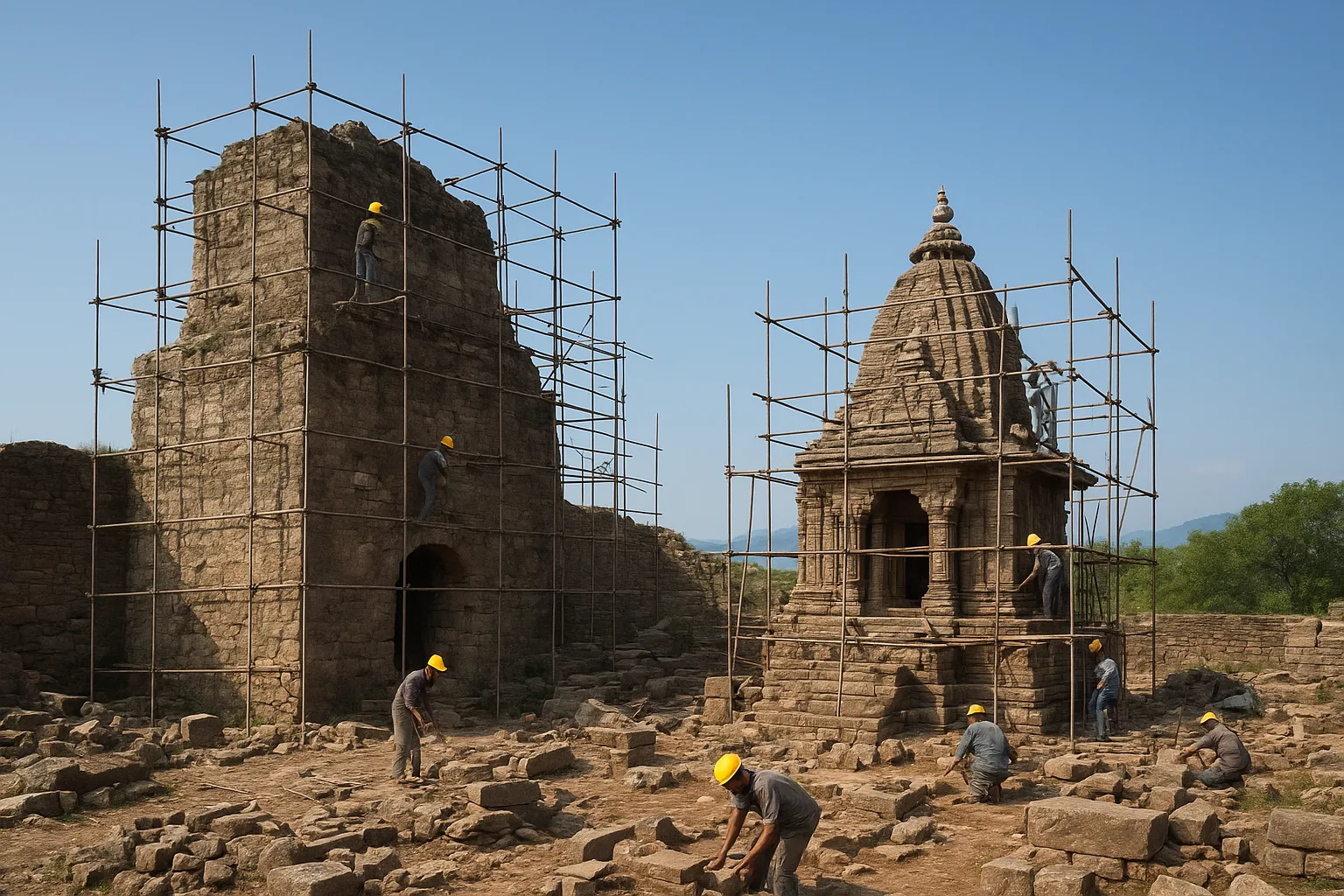
Disaster struck in 1905 when a devastating earthquake reduced vast sections of the fort and many temples to rubble. The tragedy was more than physical: it threatened to erase centuries of collective memory. Yet, in the aftermath, local communities, princely families, and the nascent Archaeological Survey of India rallied to stabilize walls, salvage sculpture, and inaugurate new rituals of remembrance. These efforts marked the beginning of a modern preservation ethos—one rooted not only in nostalgia, but in a fierce sense of identity.
Custodians of Memory: Community and Conservation
Preservation in Kangra has never been the work of a single authority. Instead, it has relied on the interwoven efforts of temple trusts, hereditary priests, local artisans, and state agencies. Oral traditions—kept alive in festivals like Navratri and in daily temple offerings—continue to supplement the gaps in written history, ensuring that the stories behind each stone are not forgotten.
In the late twentieth century, greater awareness of Kangra’s heritage led to systematic conservation projects. Restoration of the fort’s gateways, the reinforcement of temple shikharas, and the cataloguing of ancient inscriptions became collaborative projects. Schoolchildren now visit these sites on educational tours, guided by elders whose voices carry the authority of lived experience. For many, the act of preservation is an act of resistance against the erasures of time and modern development.
Heritage in the Age of Change
Today, Kangra Fort and its temples stand at the crossroads of tradition and transformation. Pilgrims and tourists mingle in the shadow of ancient ramparts, their curiosity a testament to the enduring allure of these spaces. Tensions occasionally flare between the imperatives of conservation and the demands of contemporary life—be it the pressure of new construction, the influx of visitors, or the complexities of religious politics.
Yet, even as the valley modernizes, the fort and temples remain potent symbols. They remind the people of Kangra—and those who come seeking its stories—that history survives not only in monuments, but in the rituals, memories, and everyday acts of stewardship that bind a community to its past.
Echoes of Resilience: Kangra’s Living Legacy
As dusk gathers over the valley, the silhouette of the fort looms—unyielding and serene. Its stones, battered yet steadfast, hold in their crevices the laughter of pilgrims, the prayers of generations, and the resolve of those who refused to let their heritage be forgotten. The temples, still vibrant with song and incense, continue to shape the rhythms of life in Kangra.
In preserving these monuments, Kangra keeps faith not only with its ancestors, but with its future. The work is never finished. As we look ahead, the next part of this series will turn to the evolving role of Kangra’s heritage in contemporary Himachali identity, and the new challenges and opportunities that lie beyond these ancient walls.
Previous: Urbanisation Challenges in Kangra Valley
Next: Oral Histories from Kangra Villages