
Series: History of Lahaul & Spiti, Himachal Pradesh, India
Phase 5: Modern Era — Part 27 of 30
This article appears within a continuing historical series that follows the western Himalayas into the modern era. With the end of princely rule and the integration into independent India, long-standing social and political patterns were reconfigured. This phase examines how development, state formation, and memory interact with inherited landscapes, shaping contemporary life while carrying forward echoes of the past.
Twilight on the Plateau: Memory in Stone and Story
The wind stirs dust across the empty courtyard of Tabo Monastery, painting the dying light golden against ancient walls. A solitary monk, crimson-robed, traces a path well-worn for centuries. Here, in the heart of Lahaul-Spiti, silence is a language older than any script. The Himalayas loom, fractured and eternal, bearing witness to generations who have called these high valleys home. In this moment, the living presence of monastic and tribal heritage becomes tangible—a testament to resilience amid isolation.
Anchoring the Past: Lahaul-Spiti’s Place in History
Stretching along the upper reaches of Himachal Pradesh, the twin valleys of Lahaul and Spiti lie wedged between Tibet and the fertile plains of India. Historically, this was no backwater: the region’s position straddled vital trade arteries linking Kashmir, Ladakh, and Tibet with the Indian heartland. As early as the first millennium CE, these rugged lands found mention in chronicles such as the Rajatarangini of Kashmir and later, British-era gazetteers. Yet, beneath the official records, the true fabric of Lahaul-Spiti is woven from the oral traditions and lived experiences of its people—monastic and tribal alike.
Oral Traditions, Mythology, and Ancestral Memory
Long before written chronicles, history here was sung, chanted, and whispered by elders around winter fires. In Lahaul, folk ballads recall migrations from Central Asia, the legendary hero Gushal, and the arrival of the earliest clans. Spiti’s mythology is deeply entwined with the landscape: mountains appear as petrified deities, sacred lakes as the abodes of spirits. These stories, passed down generations, are not mere fables but living repositories of memory—blending fact with the sacred, and shaping identity even as historical certainty sometimes blurs.
It is important to recognize where oral tradition diverges from documented history. The tale of the demoness subdued by Guru Padmasambhava at Tabo, for instance, is a spiritual narrative, not a verifiable event. Yet such stories encode values and social norms, giving meaning to the harsh environment and providing continuity in a world of uncertainty.
Monastic Foundations: Buddhism’s Enduring Presence
The architectural heart of Spiti lies in its monasteries—Tabo, Dhankar, Key, Kungri—each a fortress of both faith and art. The founding of Tabo Monastery in 996 CE, under the patronage of the royal family of Purang-Guge, is among the earliest well-documented milestones. Here, the walls are lined with murals that echo the cosmopolitanism of the Silk Road: Indian, Tibetan, and Central Asian influences blend in a visual testament to centuries of cross-cultural exchange.
These monastic complexes were never mere places of worship. They functioned as centers of learning, scriptoria, and archives, preserving Buddhist scriptures and local chronicles against the ravages of time and invasion. Monks not only tended to the spiritual needs of their communities but also mediated disputes and managed agricultural cycles, binding the valleys in a shared rhythm of ritual and survival.
Tribal Societies: Kinship, Custom, and Adaptation
Beyond the monastery walls, Lahaul-Spiti’s indigenous communities developed social orders adapted to their formidable environment. Lahaul’s main groups—the Bodhs, Swanglas, and Thakurs—trace descent through clan lineages, with oral genealogies jealously guarded by village elders. In Spiti, the schedule of life is dictated by the seasons: sowing barley in the brief summer, herding yaks across high pastures, and gathering for communal festivals in the long winter dark.
Customary law, handed down through generations, governed every aspect of life from marriage to land use. Tribal councils, known as yulpa or dzumsa, settled disputes and coordinated collective labor. Over centuries, these practices have absorbed influences from Hindu, Buddhist, and Bon traditions—yet always retained a distinct local color, more pragmatically attuned to survival than to doctrine.
Women and the Web of Community
In contrast to many neighboring regions, Lahaul-Spiti’s tribal societies afforded women distinct roles in property inheritance and household management. Polyandry, now rare but once common, ensured land remained undivided in families—an adaptation to the scarcity of arable soil. The resulting social fabric was tightly knit, with every member’s survival interdependent on the rest.
Trade, Hill States, and the Emergence of Political Boundaries
Through the high passes—Kunzum La, Baralacha La, and Rohtang—flowed not only traders and pilgrims but also armies and emissaries. Lahaul-Spiti’s strategic location meant that its valleys were often contested ground. From the 10th to 17th centuries, the region fell under the sway of the Guge and Purang kingdoms of western Tibet, while local chieftains and monastic authorities negotiated shifting allegiances with Ladakh, Kullu, and the larger Himalayan hill states.
Documented political history is fragmentary but suggestive. The Gazetteer of the Kangra District (1883) notes the ambiguous status of Lahaul-Spiti—sometimes tributary to Ladakh, sometimes under Kullu, and later brought into the orbit of British administration. These shifting sovereignties left their mark: tax ledgers, boundary stones, and the lingering memory of disputes over pasture, water, and trade privileges.
Bridges, Caravans, and Cultural Exchange
Trade routes were arteries of connection. Salt and wool from Tibet, barley and rice from the south, turquoise and silk from Central Asia—such goods passed through the hands of Lahauli and Spitian traders. The annual migration of karwans (caravans) was more than commerce; it was a means of cultural transmission, bringing news, ideas, and alliances that shaped the valleys for generations.
Heritage in Transition: The Modern Challenge
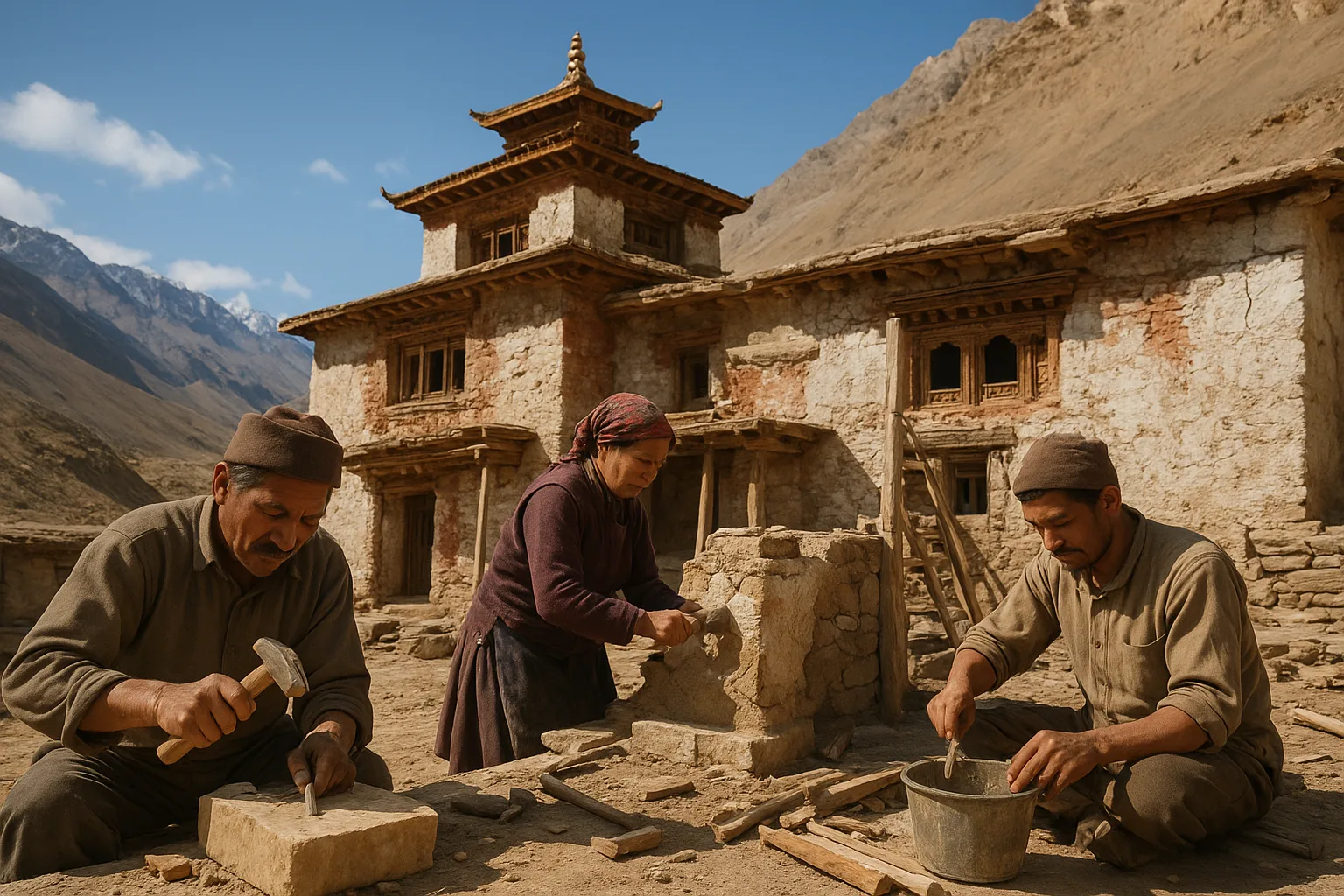
By the late 19th and early 20th centuries, the consolidation of modern state boundaries and the arrival of new roads began to redraw the map of Lahaul-Spiti. Yet even as the outside world encroached, the monastic and tribal heritage of the region proved remarkably durable. Festivals like Losar and Fagli still animate village calendars; ancient dialects echo in song and prayer. Monasteries continue to teach, and elders still recount legends that bind the past to the present.
Today, the task of preservation is both urgent and complex. Hydroelectric projects, tourism, and migration bring opportunities but also new pressures on fragile traditions. The lessons of ancient adaptation—resilience, cooperation, and reverence for the land—remain as relevant as ever. In the faces of monks, the laughter of children at festival time, and the stories whispered under the Himalayan stars, the living memory of Lahaul-Spiti endures.
Looking Ahead: Continuity and Change
The roots of Lahaul-Spiti’s identity run deep, nourished by a heritage that is both monastic and tribal, mythic and historical. As the region confronts the challenges of the 21st century, these ancient foundations offer not just continuity, but a blueprint for renewal—reminding us that preservation is not mere nostalgia, but an ongoing act of creation.
In the next part of this series, we will explore how the advent of modern governance and infrastructure transformed daily life in Lahaul-Spiti—reshaping its communities, and opening new dialogues between tradition and change.
Previous: Climate Change and Environmental Fragility
Next: Oral Traditions and Folklore of Lahaul and Spiti