
Series: History of Sirmaur, Himachal Pradesh, India
Phase 5: Modern Era — Part 26 of 30
This article appears within a continuing historical series that follows the western Himalayas into the modern era. With the end of princely rule and the integration into independent India, long-standing social and political patterns were reconfigured. This phase examines how development, state formation, and memory interact with inherited landscapes, shaping contemporary life while carrying forward echoes of the past.
Monsoon Mornings in Nahan: A Living Gateway
Clouds tumble over the Shivalik foothills as Nahan, Sirmaur’s capital, awakens to the monsoon. The town’s slender lanes, lined with colonial-era houses and ancient shrines, pulse with the quiet bustle of chai vendors and temple bells. Here, time seems layered: every turn reveals echoes of Sirmaur’s storied past, inviting visitors into a landscape where myth, memory, and history intertwine.
Sirmaur’s position—nestled along the southern edge of Himachal Pradesh—has long shaped its identity. This is a region defined by borderlands: between hills and plains, between ancient kingdoms and emergent states. Its heritage sites are not mere relics but living witnesses, each shaped by centuries of belief, migration, and trade.
Roots Beneath the Hills: Early Settlements and Myths
Local tradition holds that Sirmaur’s name derives from “Sirmour”—‘the head on the top’—a reference, perhaps, to its hilltop forts and the royal lineage that would later claim descent from the lunar dynasty. Yet, beneath the poetry of legend, the archaeological record points to a series of early settlements clustered along the Giri and Bata rivers. These waterways nourished the land and linked it to broader networks of trade and pilgrimage, connecting Sirmaur to ancient plains civilizations and Himalayan cultures alike.
Oral traditions, passed down in the Pahari dialects, speak of wandering sages, serpent deities, and hill spirits who guarded the valleys. While these tales remain unverified by material evidence, they reflect the region’s long-standing reverence for nature—a theme that endures in Sirmaur’s festivals and folk rituals. Early belief systems revolved around local deities (devtas) and ancestral spirits, whose shrines still dot the countryside.
From Trade Routes to Hill States: Sirmaur’s Strategic Emergence
By the early medieval period, Sirmaur’s valleys became crossroads for merchants and pilgrims. The lower Himalayan routes funneled salt, wool, and grains between the Punjab plains and the hill principalities further north. This economic activity fostered the rise of clustered settlements—some of which grew into fortified towns, their stone ramparts still visible today.
It was during the 11th century that Sirmaur’s political contours took clearer shape. Regional gazetteers recount the emergence of a ruling house, said to be founded by Raja Rasaloo, whose exploits straddle the line between history and epic. Over time, Sirmaur’s rulers consolidated control over key passes and valleys, negotiating with neighboring powers—Jaunsar-Bawar to the east, the rising Sikh states to the west, and the powerful Gurkhas to the north.
Temples, Forts, and Living Heritage
Many of Sirmaur’s most cherished heritage sites date to the early modern period, when the region’s hill state identity crystallized. The Renuka Lake Temple—revered as the birthplace of Parashurama—draws both pilgrims and travelers. According to myth, the lake formed from the tears of Renuka, mother of Parashurama, but local chronicles also highlight its importance as a center for trade and seasonal fairs. The temple complex, with its carved wooden facades and lakeside rituals, is a living testament to the blending of folk belief and Brahmanical tradition.
Not far from Renuka, the Shivalik temples of Trilokpur and Paonta Sahib bear witness to Sirmaur’s plural religious heritage. Trilokpur’s ancient cave shrine, dedicated to the goddess Mahamaya Bala Sundari, draws pilgrims across north India, its sanctum echoing with centuries-old hymns. In contrast, Paonta Sahib Gurudwara is a monument to Guru Gobind Singh’s sojourn in the region during the late 17th century. The site remains a vibrant center of Sikh devotion, with its marble halls and langar feeding thousands daily—a living heritage shaped by faith, migration, and hospitality.
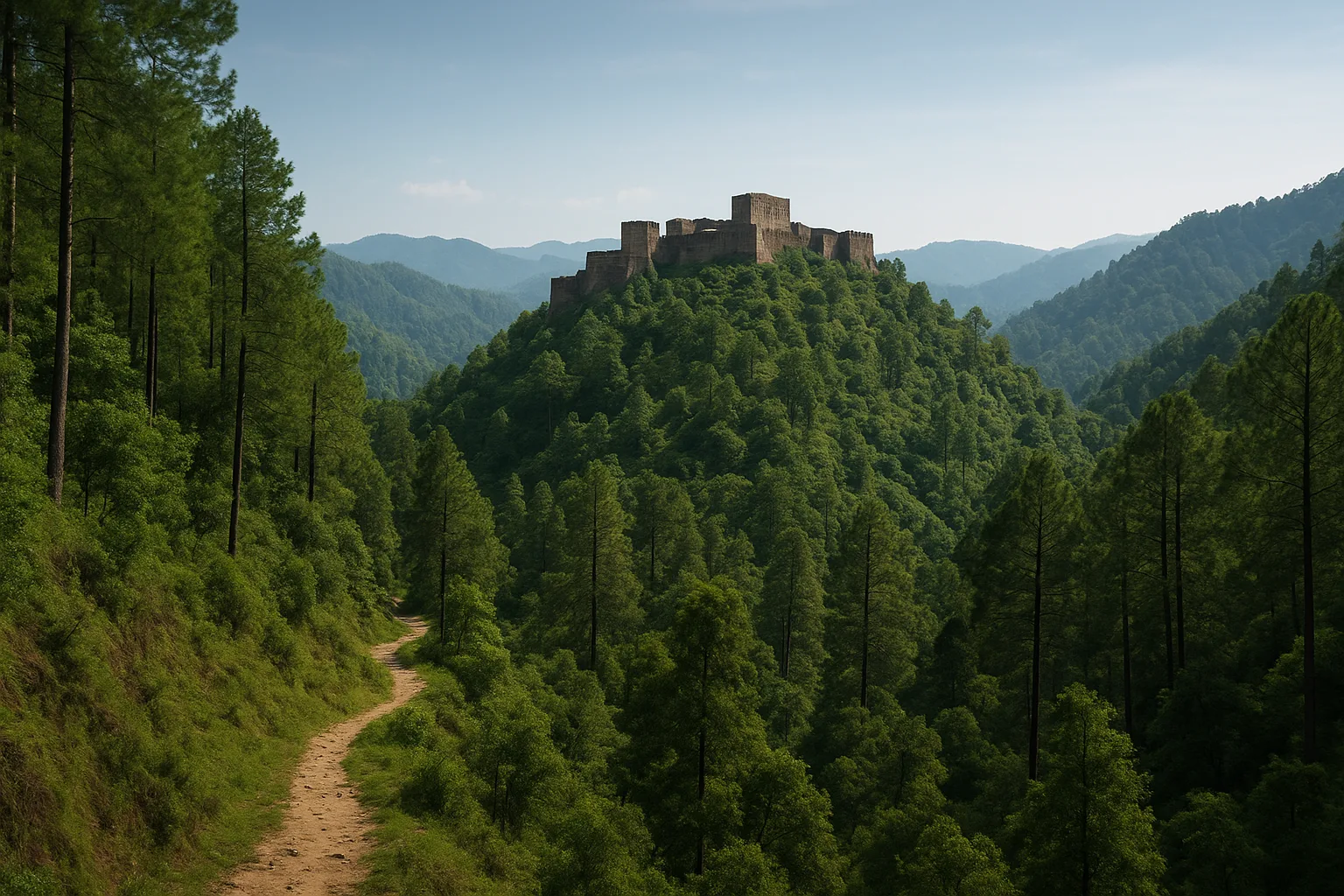
Fortresses crown the region’s hills: Jaitak Fort, perched atop a rugged spur, recalls the fierce resistance mounted by Sirmaur’s rulers—and their Gurkha adversaries—during the Anglo-Gurkha wars of the early 19th century. The battered ramparts and panoramic views evoke an era when hill states fought to preserve autonomy against imperial ambitions.
Colonial Encounters and New Traditions
Sirmaur’s encounter with British colonial power in the 19th century reshaped its built environment and patterns of life. Nahan, selected as the princely capital, saw the construction of stately gardens, clock towers, and administrative buildings that blended Victorian and Pahari styles. The Nahan Palace, with its arched corridors and painted ceilings, stands as both a relic of royal authority and a symbol of adaptation to changing times.
Markets flourished along the old caravan routes, drawing artisans and traders from distant valleys. The colonial period also brought new educational and medical institutions, some of which—like the Nahan Foundry—became landmarks in themselves, attracting early industrial workers and reformers from across the hills.
Modern Pilgrimage and Sirmaur’s Living Landscape
Today, Sirmaur’s heritage is not confined to monuments or museums—it lives in the rhythms of villages, in temple festivals, and in the stories shared in tea shops and markets. Annual fairs at Renuka, Bala Sundari, and Paonta Sahib draw thousands, weaving together communities from across Himachal and beyond. These events are not mere spectacles, but acts of cultural renewal, where ancient rituals and modern aspirations meet.
Beyond the spiritual sites, Sirmaur’s natural beauty—its cedar forests, terraced fields, and monsoon-fed rivers—has become a draw for hikers, ecotourists, and history enthusiasts alike. The region’s conservation efforts now seek to balance preservation with the pressures of modern tourism, ensuring that the lessons of the past inform the stewardship of its living heritage.
Echoes into the Present
As we move through Sirmaur’s towns and countryside, the past is never far from view. The temples, forts, and markets that once shaped dynasties and trade now anchor a sense of identity for new generations. Sirmaur’s layered history—its blend of myth, memory, and documented struggle—continues to guide how its people understand themselves and their place in the wider world.
In the next part of this series, we will trace how Sirmaur’s heritage sites have adapted through the turbulence of the 20th century—witnessing independence, migration, and the transformative forces of modernity that continue to reshape Himachal’s southern frontier.
Previous: Urban Growth in Nahan and Surrounding Towns
Next: Environmental Challenges Facing Sirmaur District