
Series: History of Kinnaur, Himachal Pradesh, India
Phase 3: Religion & Culture — Part 11 of 30
This article belongs to a historical series examining how expanding empires and regional powers reshaped life in the western Himalayan hills. As external influences pressed into the mountains, local rulers navigated diplomacy, resistance, and accommodation. This phase explores how wider political currents intersected with entrenched hill traditions, altering governance without entirely displacing older structures.
Whispered Mantras in the Mountain Air: Kinnaur, 7th Century CE
Imagine a dawn breaking over the Sutlej gorge—icy wind carrying the faint sound of conch shells and chanting. The valley’s silence is pierced by the rhythmic beat of footsteps as a small band of travelers, faces lined by sun and prayer, make their way along a precarious path. The snow-capped peaks of Kinnaur stand sentinel as they pass, carrying with them not only goods but new philosophies, stories, and rituals. These are not ordinary merchants: among them walk Buddhist monks, bearing precious scrolls and memories of lands far to the north and east.
The Ancient Land of Kinnaur: Crossroads of Civilizations
Kinnaur’s story is one of both isolation and connection. Tucked between the might of the Greater Himalayas and the rugged Zanskar range, the region’s dramatic landscape shaped its destiny. For centuries before the arrival of Buddhism, Kinnaur was inhabited by tribes whose lives revolved around the rhythms of nature and mountain spirits. Oral traditions recall the Kinners—semi-divine beings in ancient Indian mythology—whose songs and dances echo in local folklore to this day.
Yet, the valleys were no strangers to strangers. By the early centuries CE, Kinnaur sat astride an arm of the legendary Silk Route. Caravans ferried turquoise, salt, wool, and grain between India, Tibet, and Central Asia. These trails, treacherous but vital, brought with them not just commerce but new ideas. The region’s earliest belief systems were animistic, honoring local deities, stones, and sacred trees—customs that would later entwine with Buddhist practices.
Early Echoes: Oral Tradition, Myth, and Historical Inference
The precise moment when Buddhism first touched Kinnaur remains wrapped in a haze of legend and inference. Local oral histories speak of sages and magicians—some say Padmasambhava himself, the tantric master known as Guru Rinpoche, skirted these mountains on his way to Tibet in the 8th century. While such tales are impossible to prove, they reflect the region’s collective memory of a time when new faiths were taking hold.
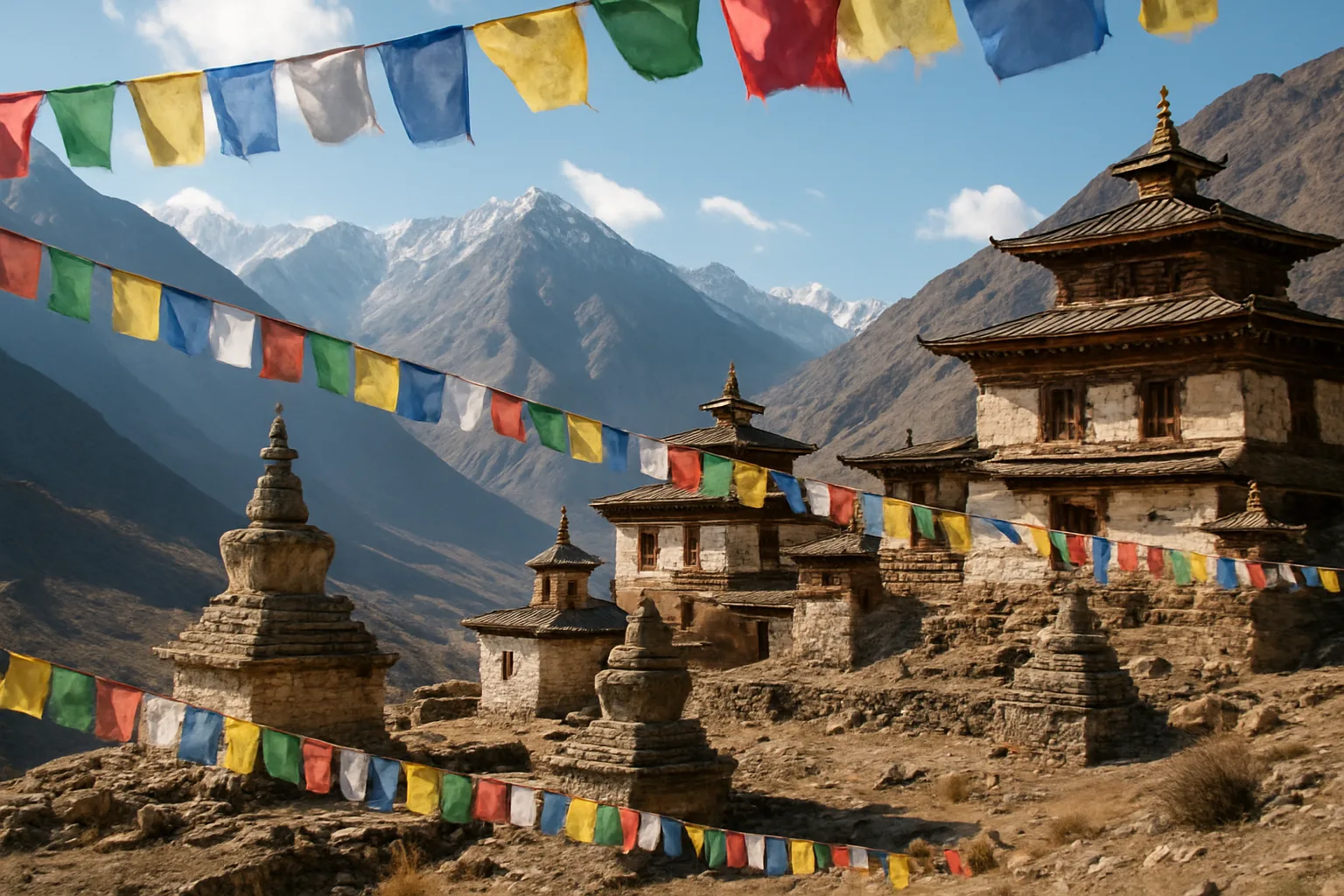
Historians, drawing from early chronicles and regional gazetteers, suggest Buddhism’s presence in Kinnaur by the 7th or 8th century CE. The spread was neither abrupt nor uniform. Rather, it filtered in gradually, woven into the fabric of existing local customs. Monks traveling from Kashmir, Ladakh, or the Spiti valley often followed the Sutlej upstream, leaving behind sacred stones, prayer flags, and—eventually—monasteries.
Buddhism and the Hill Polities: Politics, Pilgrimage, and Patronage
By the post-Gupta period, as larger empires in the plains ebbed and flowed, Kinnaur’s hill communities began to coalesce into loosely organized principalities. These emerging hill states—Chini, Kamru, and others—sometimes found themselves tributaries to neighboring powers or semi-autonomous. With shifting alliances came new opportunities for religious patronage.
Local rulers, eager to assert legitimacy and attract trade, began to support Buddhist institutions alongside ancestral cults. The Kamru fort, which would later become the seat of the Bushahr dynasty, is remembered in tradition as a place where sacred relics and Buddhist images were once housed. The intertwining of Buddhist and indigenous practices became a hallmark of Kinnauri religion. Pilgrimage routes multiplied, linking Kinnaur not only to Indian centers like Bodhgaya but to distant Lhasa and Tashilhunpo across the border.
Monks, Merchants, and Mountain Paths: How Buddhism Traveled
Buddhism’s spread through Kinnaur was as much a story of travelers as of texts. Monks from the Mahayana and later Vajrayana traditions journeyed with caravans, pausing at high-altitude camps to share stories and ritual. The new faith offered not just metaphysics but practical support for life in a harsh land: rituals for safe passage, charms against avalanches, and a cosmology that made sense of the unpredictable mountain world.
Archaeological remains—chortens (stupas) at Nako, painted frescoes in Tabo and Lippa, ancient mani stones inscribed with the mantra Om Mani Padme Hum—bear silent witness to this exchange. The first monasteries were simple, often little more than cave shrines or wooden hermitages perched above a village. Over time, these became centers of learning, gathering, and mediation for the scattered settlements of the region.
Community Transformation: Beliefs, Festivals, and Daily Life
Buddhism in Kinnaur did not erase what came before; rather, it layered itself atop older beliefs. The local devta cults—village deities with their own priests and traditions—remained central to social life. But Buddhist rituals and festivals, such as Losar (the Tibetan New Year), began to blend seamlessly with indigenous customs. Monastic festivals drew villagers from days away, while Buddhist lamas became respected arbiters in disputes and keepers of agricultural calendars.
Through the centuries, Kinnauri society developed a spiritual duality. Households honored both the Buddhist pantheon and the local spirits, performing rites at home and in the monastery alike. This syncretic tradition set Kinnaur apart from more orthodox Buddhist regions and lent a distinct flavor to its art, architecture, and storytelling.
Legacy Among the Peaks: Buddhism’s Enduring Imprint
By the time the great Himalayan polities—Bushahr, Ladakh, Tibet—contested these borderlands in the medieval era, Buddhism was firmly rooted in Kinnauri soil. Its influence persisted through centuries of political turbulence, adapting to each new wave of rulers and reformers. Today, the shrines and monasteries of Kinnaur stand as living testaments to this long journey. Prayer wheels spin beside ancient stone altars, and the chants of novice monks mingle with the songs of shepherds.
Modern Kinnaur remains a place where Buddhism is not merely a faith but a way of moving through the world—resilient, adaptable, and deeply intertwined with the land. The ancient threads of Buddhist practice continue to shape identity, art, and community life, even as new influences arrive from beyond the passes.
In the next part of our series, we will walk deeper into the sacred spaces of Kinnaur: its monasteries, temple rituals, and the spiritual geography that continues to draw pilgrims and seekers to these remote valleys.
Previous: Cultural Exchange Between Kinnaur and Tibet
Next: Hindu–Buddhist Syncretism in Kinnaur Society