
Series: History of Chamba, Himachal Pradesh, India
Phase 3: Culture & Art — Part 12 of 30
This article belongs to a historical series examining how expanding empires and regional powers reshaped life in the western Himalayan hills. As external influences pressed into the mountains, local rulers navigated diplomacy, resistance, and accommodation. This phase explores how wider political currents intersected with entrenched hill traditions, altering governance without entirely displacing older structures.
The Dawn of Painted Stories
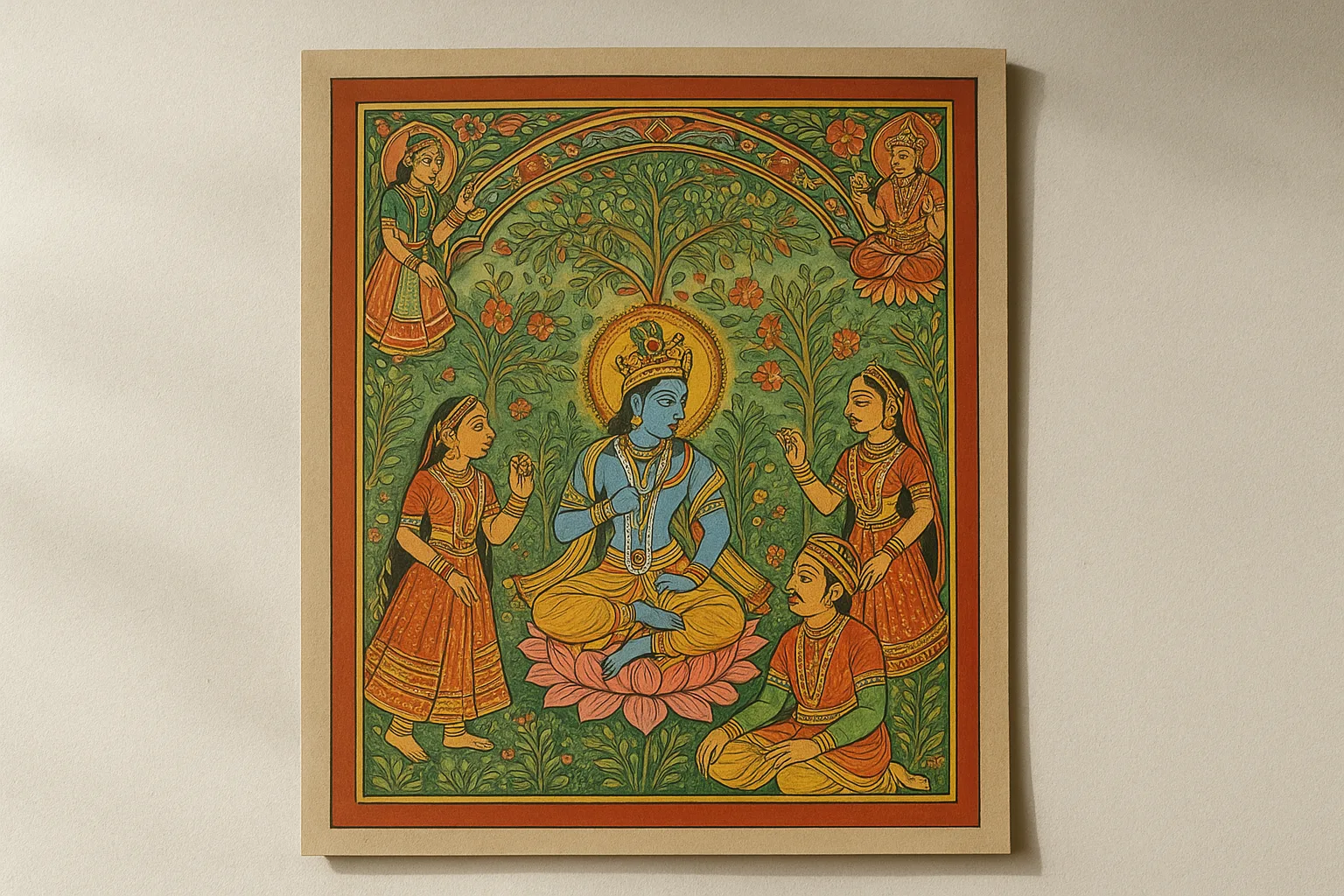
As the sun rises over the Ravi Valley, the first rays filter through cedar forests and illuminate the white walls of Chamba’s ancient palaces. Inside these quiet halls, a different kind of light has long flickered: the gleam of gold leaf, the delicate shimmer of mineral pigments, and the vibrant scenes of gods, lovers, and monarchs unfurled on sheets of handmade paper. This is the world of Chamba miniature paintings—an art form that blossomed in the Himalayan foothills, blending royal ambition, devotional fervor, and the age-old rhythms of mountain life.
Chamba in the Tapestry of the Western Himalaya
Before the first brush ever touched paper in Chamba, the region was a crossroads of cultures and kingdoms. By the early medieval period, Chamba stood at the confluence of ancient trade routes threading north toward Ladakh and west to Kashmir. The land’s strategic valleys and hill passes made it a coveted prize for emerging hill states, each ruled by dynasties tracing their legitimacy to distant, often legendary ancestors.
Local chronicles, such as the Tarikh-i-Rajgan-i-Chamba and the detailed British-era gazetteers, root Chamba’s political history in the late 10th century. Raja Sahil Varman’s founding of the capital here in 920 CE marked not only a new seat of power but also the dawn of a regionally distinct court culture. Yet, alongside these documented events, oral traditions abound—tales of local deities intervening in royal affairs, of wandering ascetics inspiring kings, and of the land’s sanctity shaping its destiny. These stories, while not always historically verifiable, set the stage for an art form steeped in both myth and monarchy.
Faith, Community, and the Birth of the Chamba Aesthetic
Chamba’s early society was a mosaic of Pahari-speaking hill folk, itinerant traders, and Brahmin priests, all living in the shadow of sacred peaks. The cults of Shiva, Vishnu, and the goddess Devi mingled with ancient animist beliefs, anchoring everyday life in ritual and festival. Temples—carved from wood or raised in stone—became the focal points for artistic patronage, their walls and sanctums adorned with painted and sculpted images.
As the Chamba rajas consolidated power, they drew skilled artisans from across the hills. Some traditions hold that artists arrived from distant Kashmir, fleeing political upheaval during the 15th and 16th centuries. Others suggest local families, such as the famed Basohli and Guler ateliers, migrated into Chamba, bringing with them the techniques and iconography of neighboring courts. What emerges from both oral memory and archival records is a sense of artistic migration—painters adapting to new patrons, new stories, and the dramatic Himalayan landscape itself.
The Royal Workshops: Patronage and Innovation
By the late 17th century, the Chamba court had become a vibrant center for miniature painting. Raja Udai Singh (reigned 1690–1720) stands out as a pivotal figure, remembered in both chronicles and temple inscriptions for his devotion to the arts. The royal atelier—far from a single room—was a network of master painters, apprentices, scribes, and pigment grinders. Their work ranged from manuscript illustration to elaborate portraiture, with themes drawn from Sanskrit epics, Vaishnavite devotional poetry, and local legends.
The Chamba style did not emerge in isolation. Influences from Kangra, Basohli, and Mughal workshops are evident in the swirling landscapes, expressive faces, and ornate borders. Yet, Chamba paintings developed a unique signature: a luminous palette heavy on vermilion and turquoise, delicate gold highlights, and a profound sense of intimacy. Scenes of Radha and Krishna, rendered with a gentle lyricism, alternate with vibrant processions, hunting scenes, and depictions of the region’s own deities—Chaugan Mata, Chanchal Devi, and the many-faced Maheshwar.
Technique and Symbolism: The Language of Chamba Painting
The technical mastery behind Chamba miniatures is as remarkable as their beauty. Artists worked with squirrel-hair brushes, hand-ground pigments, and burnished paper or cloth. Each stage of production—preparing the surface, sketching the outline, layering color and gold, and finally adding minute details—was both meditative ritual and collective endeavor. The process itself was often shrouded in secrecy, knowledge passed down within families or tightly-knit guilds.
Symbolism runs deep. The lotus, peacock, and riverbank recur as motifs, evoking both the natural world and the spiritual landscape of Chamba. Colors serve as emotional cues: deep indigo for longing, bright yellow for the divine, crimson for royal authority. Even the smallest details—a half-turned gaze, a fluttering scarf—carry layers of meaning, meant to be read by a courtly audience attuned to the language of gesture and myth.
Patrons, Painters, and the Wider World
While the Chamba rajas remained the chief patrons, the reach of these paintings extended beyond the palace. Merchants commissioned illustrated manuscripts for their personal shrines; temple trusts sought devotional panels for festival display. By the 18th and 19th centuries, Chamba paintings were exchanged as diplomatic gifts—tokens of alliance, piety, or rivalry with neighboring states like Mandi, Kullu, and Kashmir. The British arrival in the hills, chronicled meticulously in gazetteers and travelers’ memoirs, brought new audiences but also new pressures. Some artists adapted, producing works for colonial collectors; others clung to traditional forms, even as courtly patronage waned.
Despite cycles of upheaval, the core of Chamba painting endured: a reverence for detail, an intimacy with landscape and legend, and an unbroken line of artistic transmission. The oral histories of painter families, the quiet pride of village elders, and the festival rituals that still incorporate painted banners all speak to this remarkable continuity.
Legacy and Living Tradition
Today, the echoes of Chamba’s miniature paintings linger in the town’s museums, temple sanctuaries, and family archives. Local artists, some direct descendants of the court ateliers, continue to teach the old techniques, adapting them for a new era. The annual Minjar festival, with its processions and devotional art displays, keeps alive the spirit of community patronage. Visitors tracing the winding lanes of Chamba still encounter the motifs—peacocks, lotuses, celestial lovers—adorning prayer halls and market stalls.
The story of Chamba miniature painting is not merely a tale of royal courts and vanished kingdoms. It is a living thread, tying the region’s past to its present: a testimony to cultural resilience, artistic ingenuity, and the enduring power of painted stories in the Himalaya.
As we continue this journey through Chamba’s cultural landscape, the next post will delve deeper into the musical traditions that once filled these same palace halls and temple courtyards—revealing how sound and color, faith and artistry, together shaped Chamba’s singular identity.
Previous: Chamba Rumal: History of a Unique Craft
Next: Temples and Ritual Life in Medieval Chamba