
Series: History of Mandi, Himachal Pradesh, India
Phase 3: Temples, Faith & Culture — Part 12 of 30
This article belongs to a historical series examining how expanding empires and regional powers reshaped life in the western Himalayan hills. As external influences pressed into the mountains, local rulers navigated diplomacy, resistance, and accommodation. This phase explores how wider political currents intersected with entrenched hill traditions, altering governance without entirely displacing older structures.
Before the Bells: Dawn at Bhootnath
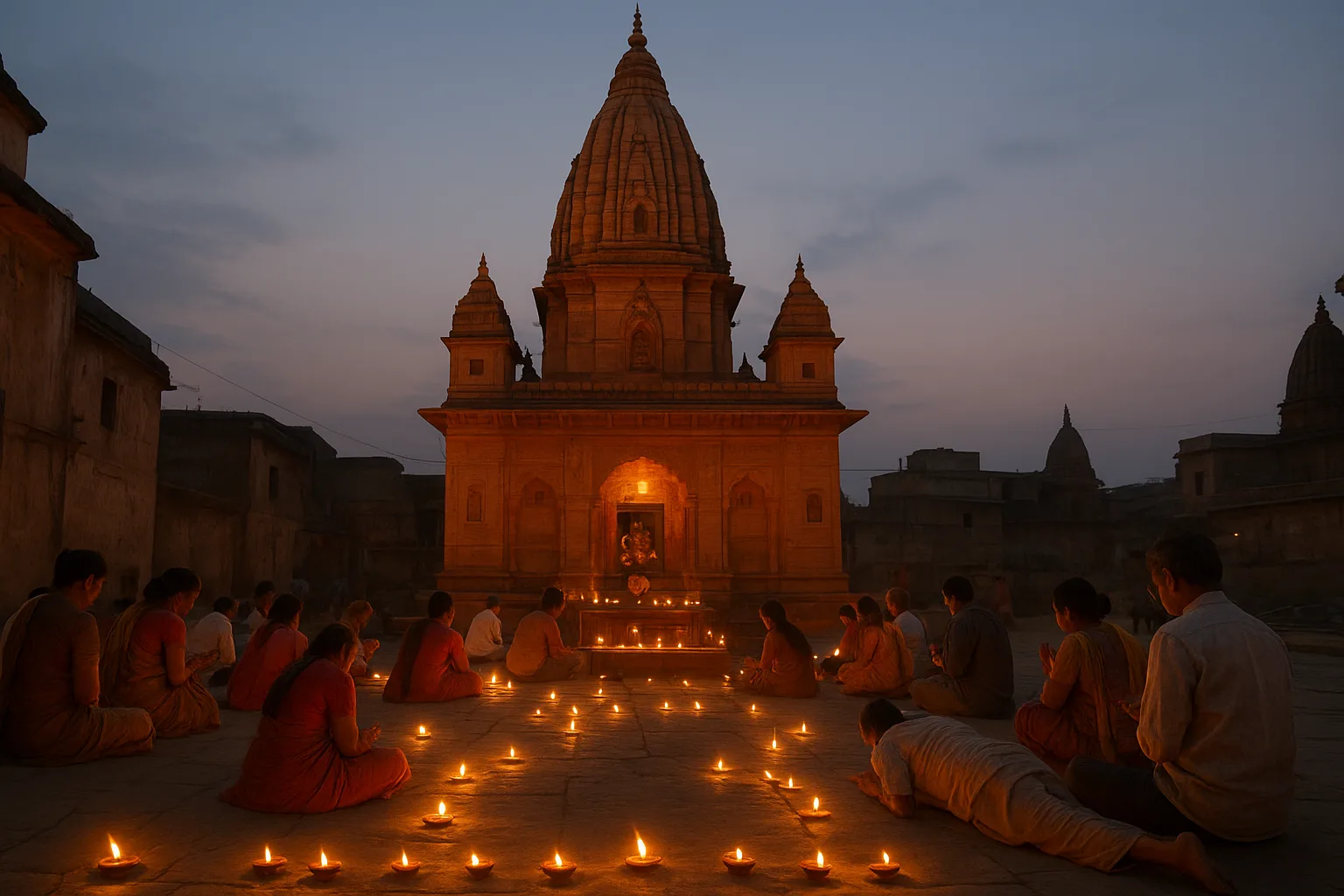
The sky above Mandi is still an indigo hush when the first conch shell sounds from the Bhootnath Temple. The stone structure, veiled in winter mist, rises above the Beas River’s quiet current. Pilgrims—old women in woolen shawls, barefoot boys—move up the steps, their breaths visible in the cold. Somewhere inside, oil lamps flicker against temple walls blackened by centuries of incense. This is not just another Himalayan shrine; this is the spiritual heart of Mandi and the stage for a history where myth and power, devotion and politics, have always intertwined.
Valley of Crossroads: The Early Mandi Region
Long before the temple’s first foundation was laid, the ancient valley at the confluence of the Beas and Suketi rivers drew people seeking fertile land, safe passage, and spiritual refuge. The hills that cradle Mandi lie at the intersection of old trade routes—one leading down to Kangra and the Punjab plains, another winding up toward Kullu and beyond into Tibet. By the first millennium CE, these craggy corridors saw a mosaic of communities: shepherds, early farmers, traders, and mendicants.
Oral traditions preserved by local bards speak of pre-Hindu spirits—devis and devtas—who roamed these hills long before the great temples appeared. Each spring, villagers honored them in sylvan glades with offerings of grain and goat. Yet, as waves of migration and faith swept the western Himalayas, the region’s spiritual landscape began to shift. The earliest written mentions of the area—found in regional gazetteers and Rajput chronicles—hint at a patchwork of small settlements and proto-states, each with its own guardian deity and clan chieftain.
Myth, Memory, and the Making of Bhootnath
The founding legend of Bhootnath Temple, cherished in Mandi’s oral tradition, tells of King Ajbar Sen—the purported founder of modern Mandi—who, in the 16th century, dreamt of Lord Shiva commanding him to build a shrine at this precise spot. Some versions claim the king unearthed a self-manifested lingam (aniconic form of Shiva) while clearing land for his new capital. Others entwine the story with local folk deities, suggesting the temple’s sanctity predates even Ajbar Sen’s reign.
While these tales invoke a sense of cosmic destiny, historical inference suggests a more pragmatic fusion—one in which the new Rajput rulers sought to anchor their authority by associating themselves with universal Hindu symbols and ancient local cults. By building Bhootnath at the heart of the emerging capital, Ajbar Sen and his successors cast their dynasty as both temporal and spiritual custodians of the land.
The Rise of Hill States and Temple Patronage
The 16th and 17th centuries saw the consolidation of several small hill states in the Western Himalayas. As Mandi’s rulers asserted control, they invested heavily in public works, fortresses, and—most significantly—temples. These structures did more than serve the faithful. They legitimized royal authority, centralized economic activity, and offered a stage for seasonal festivals that bound scattered communities into a shared cultural orbit.
Chronicles and copper-plate grants from the period reveal how temples like Bhootnath became repositories of both spiritual and material wealth. Land, cattle, and even villages were gifted to the temple, attracting priests, artisans, and scholars. In the shaded courtyards, one could hear Sanskrit chants mingle with the dialects of traders or the songs of exiled bards from neighboring states. Mandi, once a collection of hamlets, emerged as a bustling entrepôt—its fortunes increasingly tied to the rhythms of pilgrimage and festival.
Architecture and Ritual: A Living Tradition
The Bhootnath Temple, with its distinctive shikhara (spire) and stone mandapa (hall), exemplifies the hill style of North Indian temple architecture. Unlike the soaring temples of the plains, its proportions are compact, its ornamentation restrained—a reflection of both seismic realities and local aesthetic sensibilities. Over the centuries, the temple has been expanded and repaired by successive rulers, each leaving their subtle mark in carved panels or bronze bells.
Yet it is the living ritual that gives Bhootnath its enduring power. Every spring, the temple becomes the epicenter of the Mandi Shivratri Fair—a festival that draws not only townsfolk but delegations from across Himachal and beyond. The fair is both sacred and secular: a week of processions, music, commerce, and diplomacy that echoes the ancient role of temples as civic as well as spiritual centers. Oral histories recall moments when rival hill chiefs met here under the temple’s shadow to negotiate alliances—or settle old scores—under the watchful gaze of Shiva.
Faith in Flux: Bhootnath in the Modern Era
Through colonial rule, independence, and the march of modernity, Bhootnath Temple has remained a constant, even as the world around it transformed. The Gazetteer of the Kangra District (1883) noted how the temple’s annual fair had become a regional attraction, fostering both economic exchange and communal identity. Yet, the 20th century also saw challenges: urbanization, changing patterns of devotion, and the rise of new civic institutions.
Still, the temple’s bells ring on. Today, pilgrims share space with tourists and students; old priests recite ancient mantras alongside the hum of mobile phones. The Bhootnath Temple is no relic. It is a living, breathing heart that continues to pulse with the anxieties and aspirations of the people of Mandi.
An Enduring Center: Bhootnath’s Legacy in Contemporary Mandi
As the first light catches the temple’s brass trident, a small crowd gathers for morning aarti. Young and old, laborer and merchant, local and visitor—all stand together, hands folded, faces lit by the flames. In that brief moment, the centuries collapse, and the ancient vision of Mandi as a crossroads—of faith, trade, and community—comes alive once more.
The story of Bhootnath Temple is inseparable from the story of Mandi itself: a tale of migration and settlement, of dynasties and commoners, of myth woven into the fabric of daily life. Its stone walls and sacred rituals remind us that the roots of belonging run deep, and that places of worship are not merely markers of the past but anchors for the present.
In our next chapter, we’ll walk beyond Bhootnath’s shadow to explore the constellation of temples, shrines, and sacred groves that shaped the cultural tapestry of ancient Mandi—and continue to nourish its soul today.
Previous: The 81 Temples of Mandi: History, Legends, and Faith
Next: Triloknath Temple: Architecture, Mythology, and History