
Series: History of Chamba, Himachal Pradesh, India
Phase 2: Medieval Kingdom — Part 10 of 30
This article forms part of a continuing series that follows the gradual emergence of organised power in the western Himalayas. As small communities gave way to clans, chieftainships, and hill states, patterns of rule, alliance, and conflict began to take shape. This phase examines how authority was negotiated through land, ritual, and warfare, laying the groundwork for regional kingdoms that would dominate the medieval landscape.
Twilight in the Valley: Chamba’s Mountain Crossroads
In the cool hush of a medieval morning, as mist curled above the Ravi River and pine needles glistened with dew, a caravan wound its way through the dense forests northwest of Chamba. Laden mules, draped in handwoven saddlebags, trod ancient footpaths—some barely wider than a man’s shoulders—while traders murmured in a mix of Pahari dialects, their voices rising above the river’s low thunder. The air was thick with the scent of cedar and the faint tang of spices—pepper from the south, saffron from the north. This was more than a journey; it was the living artery of commerce, belief, and kinship that had bound Chamba to Kashmir for centuries.
Chamba’s Geography: The Land Between Ranges
Set between the Dhauladhar and Pir Panjal ranges, Chamba’s steep valleys form a natural corridor connecting the Himalayan foothills with the high plateaus of Kashmir. The Ravi River, originating near Bara Bhangal, snakes through this landscape, carving deep gorges and shaping settlement patterns since ancient times. Early chroniclers—like those whose accounts would later inform the Chamba State Gazetteers—describe a land both remote and strategically placed, a bridge between the Punjab plains and the storied valleys of Kashmir.
Archaeological traces, from copper plate grants to remnants of early shrines, suggest that by the early medieval period (circa 7th to 10th centuries CE), Chamba had emerged as a nexus of small settlements, each clustered around a fortified stronghold or temple, and sustained by the movement of goods and ideas along these riverine routes.
Oral Traditions and Mythic Pathways
Local legend—preserved in the folk songs of the Gaddi shepherds and echoed in the oral histories passed down by temple priests—speaks of even older connections. According to one enduring tale, the goddess Chameshni herself guided the earliest settlers into the region, revealing hidden tracks northward toward the snows of Kashmir. Such stories, embroidered over generations, blend myth and memory; while not strictly historical, they reflect the deep-rooted sense that Chamba’s lifeblood always pulsed with movement and exchange.
These oral traditions, while evocative, must be read alongside more tangible records. The routes they describe often align with the practical needs of seasonal migration, pilgrimage, and trade—suggesting that the mythic and the material were never far apart.
From Tribal Settlements to Emerging Hill States
By the early medieval era, Chamba’s valleys hosted a mosaic of communities: pastoral Gaddis moving with their flocks, settled agriculturalists cultivating terraced fields, and merchant families tracing their lineages to distant lands. The rise of the Chamba kingdom itself, traditionally dated to the 10th century under Raja Sahil Varman, marked a new phase in the region’s history. Political chronicles—such as the Rajatarangini of Kashmir—occasionally reference the shifting allegiances and tributary ties that bound these hill states to more powerful neighbors.
Historical inference suggests that Chamba’s rulers, much like their contemporaries in Jammu or Kangra, relied on their control of strategic passes to negotiate autonomy and prosperity. The town of Chamba, founded on the banks of the Ravi, became not only a royal capital but also a bustling hub where merchants, pilgrims, and emissaries from Kashmir and beyond might trade silk, salt, and stories beneath the shadow of its ancient temples.
Mapping the Routes: Pathways Through the Mountains
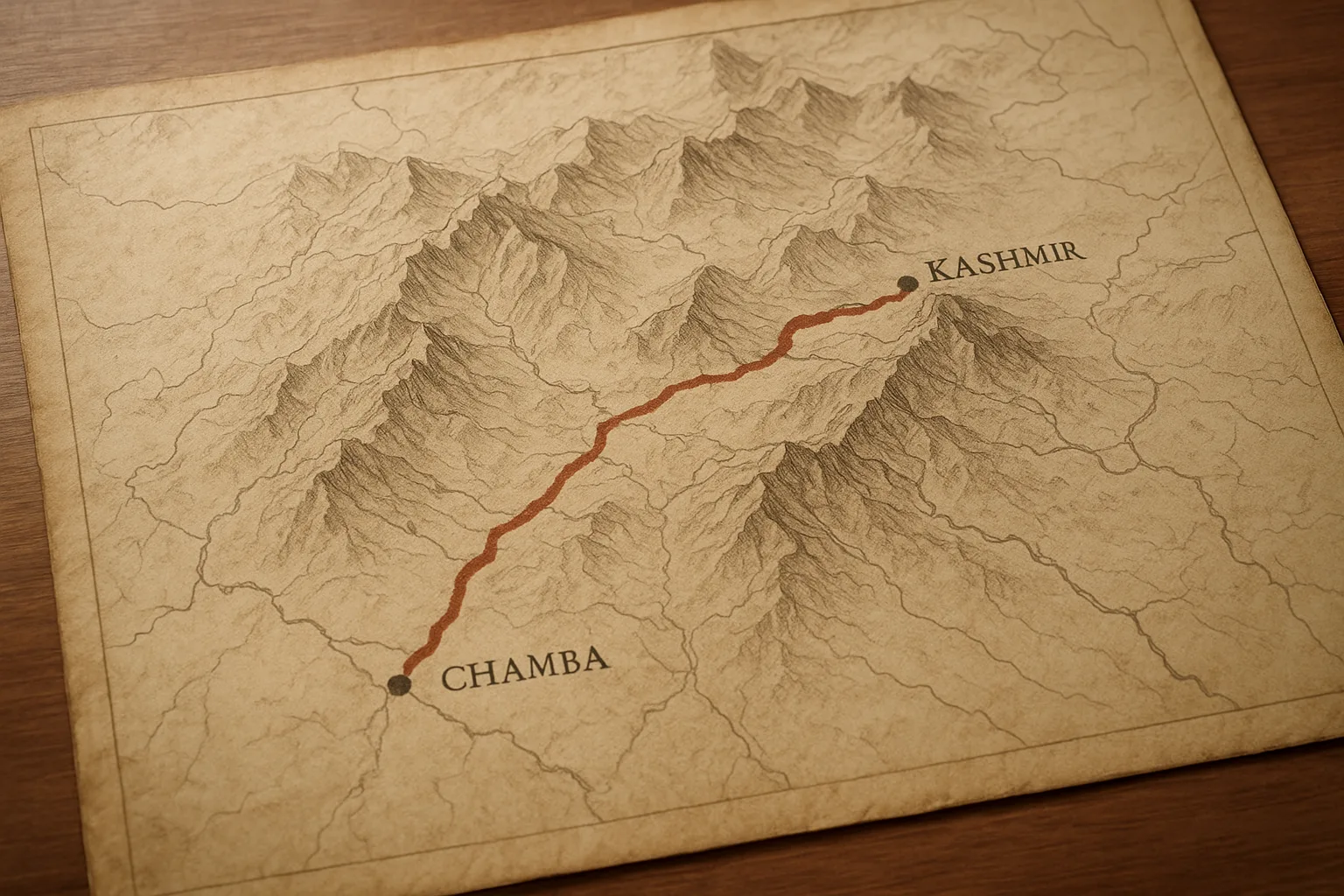
Several main arteries connected Chamba with Kashmir. The most significant ran northwest through the passes of Tissa and Bhadarwah, following the course of the Ravi and Chenab rivers before crossing into the verdant valleys of southern Kashmir. These routes, described in later Mughal records and still visible in segments today, were treacherous in winter but vital in summer, when caravans brought saffron, pashmina wool, and dried fruits southward, returning with salt, grain, and manufactured goods from the plains.
Other paths wound eastward toward Lahaul and into Ladakh, or south to Kangra and the Punjab plains. Each route was shaped by geography but also by shifting political realities—fortified by hill chiefs, taxed at river crossings, and sometimes menaced by bandits or seasonal floods. Over time, these tracks became arteries not just of commerce, but of cultural transmission. Buddhist pilgrims, Hindu sadhus, and later Muslim traders all left their imprint on the region’s languages, artistic traditions, and religious life.
Encounters Along the Way: Communities and Commerce
Trader communities—many of whom traced their ancestry to Rajput, Kashmiri, or even Central Asian merchants—settled in market towns along the main routes. Bazaars like the one at Bharmaur thrived as waystations, while itinerant artisans introduced new forms of metalwork, weaving, and miniature painting. The influence of Kashmir, famed for its sophisticated court culture, is evident in Chamba’s enduring traditions of temple architecture and manuscript illustration. Even today, the intricate embroidery of Chamba rumals and the delicate lines of local pahari painting bear witness to these centuries of exchange.
The movement of goods was inseparable from the movement of people and ideas. Sufi mystics, Buddhist monks, and Shaivite ascetics traveled the same roads, spreading philosophies and forging new syncretic practices. Festivals and fairs, often timed to coincide with the arrival of distant traders or the return of migratory shepherds, became occasions for shared celebration and negotiation.
Documented History: Chronicles and Gazetteers
From the 14th century onward, as Sultanates and then the Mughal Empire extended their reach, the records become more concrete. Imperial chroniclers and local scribes referenced the importance of Chamba’s routes—not only for trade, but as corridors for armies and diplomacy. The Chamba State Gazetteer, compiled much later in the colonial period, drew on these earlier accounts to document the enduring significance of these pathways. Even as larger polities vied for control, Chamba’s strategic position ensured that it retained a measure of independence, negotiating tribute and passage with skillful diplomacy.
These chronicles, while often focused on rulers and wars, also preserve glimpses of everyday life: tolls paid at mountain passes, disputes over grazing rights, and the rhythms of regional fairs. They reveal a region shaped as much by its connections as its isolation—a place where the world came, not just passed through.
Legacy and Living Memory
Today, as jeeps and buses ply the roads once trodden by mule caravans, echoes of this history linger in Chamba’s festivals, in the names of mountain passes, and in the shared memories of its people. The ancient routes may have faded from maps, but they survive in the region’s music, its craft traditions, and its cosmopolitan spirit. Chamba’s sense of identity remains rooted in its history as a crossroads—between kingdoms, cultures, and worlds.
As we trace the evolution of Chamba’s medieval kingdom in the next part of this series, we will follow the rise of its royal lineages and the building of its iconic temples—monuments to a region shaped by passage, exchange, and resilience.
Previous: Wars, Alliances, and Hill Politics of Chamba
Next: Chamba Rumal: History of a Unique Craft