
Series: History of Shimla, Himachal Pradesh, India
Phase 2: Medieval Period — Part 7 of 30
This article forms part of a continuing series that follows the gradual emergence of organised power in the western Himalayas. As small communities gave way to clans, chieftainships, and hill states, patterns of rule, alliance, and conflict began to take shape. This phase examines how authority was negotiated through land, ritual, and warfare, laying the groundwork for regional kingdoms that would dominate the medieval landscape.
Along the Mountain Paths: A Medieval Scene
In the cool half-light of a Himalayan dawn, the ridges near present-day Shimla would have echoed with the distant clatter of hooves and the muted conversation of traders making their way across the high passes. The forests were dense, the paths uncertain, and yet the region stood witness to centuries of movement—of people, beliefs, and political ambitions. Here, in the shadow of the lofty Himalayas, a new power was gradually asserting itself: the hill state of Bushahr.
Geography and Early Historical Anchors
The region that would later be known as Shimla occupies a strategic position in the central Himalayas, situated along ancient routes that connected the fertile Sutlej Valley to the upper reaches of modern Himachal Pradesh. By the early second millennium CE, these hills were home to a tapestry of small communities—pastoralists, cultivators, and traders—each shaped by the rhythms of the land and the demands of altitude.
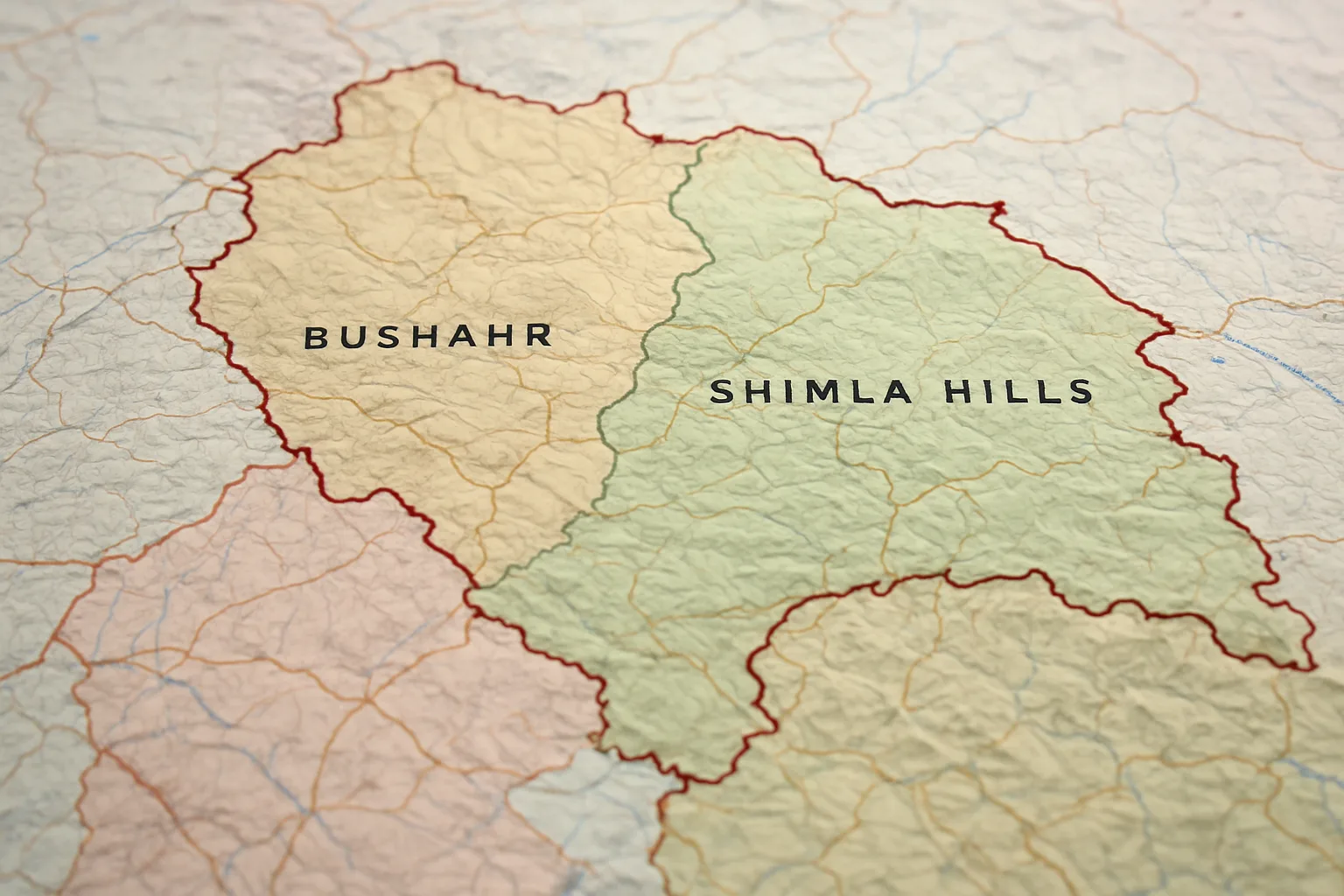
Documented history places the rise of Bushahr State in the upper Sutlej valley by the 7th or 8th century CE, though its precise origins remain a subject of local tradition and subsequent chronicling. Regional gazetteers compiled during the colonial period frequently reference the shifting boundaries and spheres of influence among the hill states, with Bushahr gradually extending its reach toward the south and east, including the territories that now comprise Shimla district.
Oral Tradition and the Shaping of Identity
Oral traditions among the hill communities recount a landscape marked by legendary figures and local deities. In the villages that dotted the ridgelines, tales of the Pandavas’ wanderings and the exploits of mythic rajas provided a sense of continuity with a distant, heroic age. These stories, preserved in folk songs and seasonal festivals, helped bind together otherwise scattered settlements, fostering a shared identity distinct from the plains below.
Yet, these traditions also reflected the realities of a region in flux. The arrival of Bushahr’s emissaries and tax collectors, the construction of hill forts (known locally as kot), and new patterns of tribute and allegiance all entered the oral record, often woven into legends of wise rulers or miraculous interventions by local gods.
Emerging Communities and Cultural Mosaic
By the medieval period, the Shimla region was inhabited by sturdy agrarian communities—most notably the Kanets and Brahmins—alongside pastoral groups such as the Gujjars and Gaddis, who moved their flocks with the seasons. The villages clung to the slopes and valleys, their fields carved from the forest margins.
The development of permanent settlements was closely tied to the patterns of patronage and security established by the expanding hill states. The chiefs of Bushahr, seeking to consolidate their rule, encouraged the clearing of new land and offered protection in return for loyalty and revenue. Over time, this fostered a network of villages bound by kinship, custom, and obligation to the ruling house of Bushahr.
Belief Systems and Sacred Landscapes
The spiritual life of the region reflected a blend of ancient traditions and local innovation. The worship of indigenous deities—often associated with particular groves, rivers, or mountaintops—remained central to village life. Shrines to deities such as Mahasu, Shali, and Jakhoo marked the landscape, serving as both religious centers and symbols of local autonomy.
Historical inference suggests that as Bushahr’s influence grew, it did not seek to displace these beliefs but rather incorporated them into its own system of rule. Local gods were sometimes invoked as witnesses in legal matters, and festivals became occasions for the display of both spiritual and political authority.
Trade Routes, Forts, and Political Realignment
The ridges and valleys of Shimla formed part of a network of routes linking the Sutlej basin with the upper hills and the plains beyond. Traders carried salt, wool, and grain, while pilgrims and itinerant monks contributed to the flow of ideas and practices. The control of these routes was a source of wealth and prestige, and it is here that the ambitions of Bushahr State became most visible.
Historical records indicate that, by the 14th and 15th centuries, Bushahr had established a series of outposts and forts along key passes, including regions adjacent to modern Shimla. These fortified sites functioned as administrative centers, collection points for tribute, and bulwarks against rival hill chiefs or raiding bands. The political map of the region was anything but static; alliances shifted, and periods of autonomy alternated with vassalage to more powerful neighbors.
Shimla’s Gradual Integration and the Legacy of Bushahr
By the late medieval period, the territories around Shimla had come increasingly under the sphere of Bushahr’s influence. While direct control fluctuated, the imprint of Bushahr’s administrative and cultural systems became steadily more pronounced. Local chieftains, known as thakurs or ranas, negotiated their status through tribute and service, while village communities adapted to new expectations of revenue and governance.
This period laid the groundwork for the region’s later political evolution. The patterns of land tenure, the rhythms of religious life, and even the architecture of hill forts and temples bore the mark of Bushahr’s centuries-long engagement with the southern Himalayas.
Continuities and Looking Forward
Today, traces of this medieval past endure in the rituals, festivals, and social organization of villages across the Shimla hills. The memory of Bushahr’s influence persists in local folklore and in the structures that still stand sentinel over ancient routes. As the series continues, we will follow the region’s journey into the early modern era, when new powers and outside interests began to reshape the destiny of Shimla and its people.
Previous: Hill Chiefs and Local Governance in Medieval Shimla
Next: Village Life and Economy in Medieval Shimla Hills