
Series: History of Mandi, Himachal Pradesh, India
Phase 1: Ancient & Mythological Roots — Part 4 of 30
This article is part of a broader historical series exploring the earliest layers of human presence in the western Himalayas. Beginning with landscape, belief, and early patterns of movement and settlement, the series traces how communities adapted to mountainous environments long before formal states or written records emerged. These foundational centuries shaped cultural memory, local traditions, and relationships with the land that would endure through later periods of change.
River Mist Over Ancient Stones
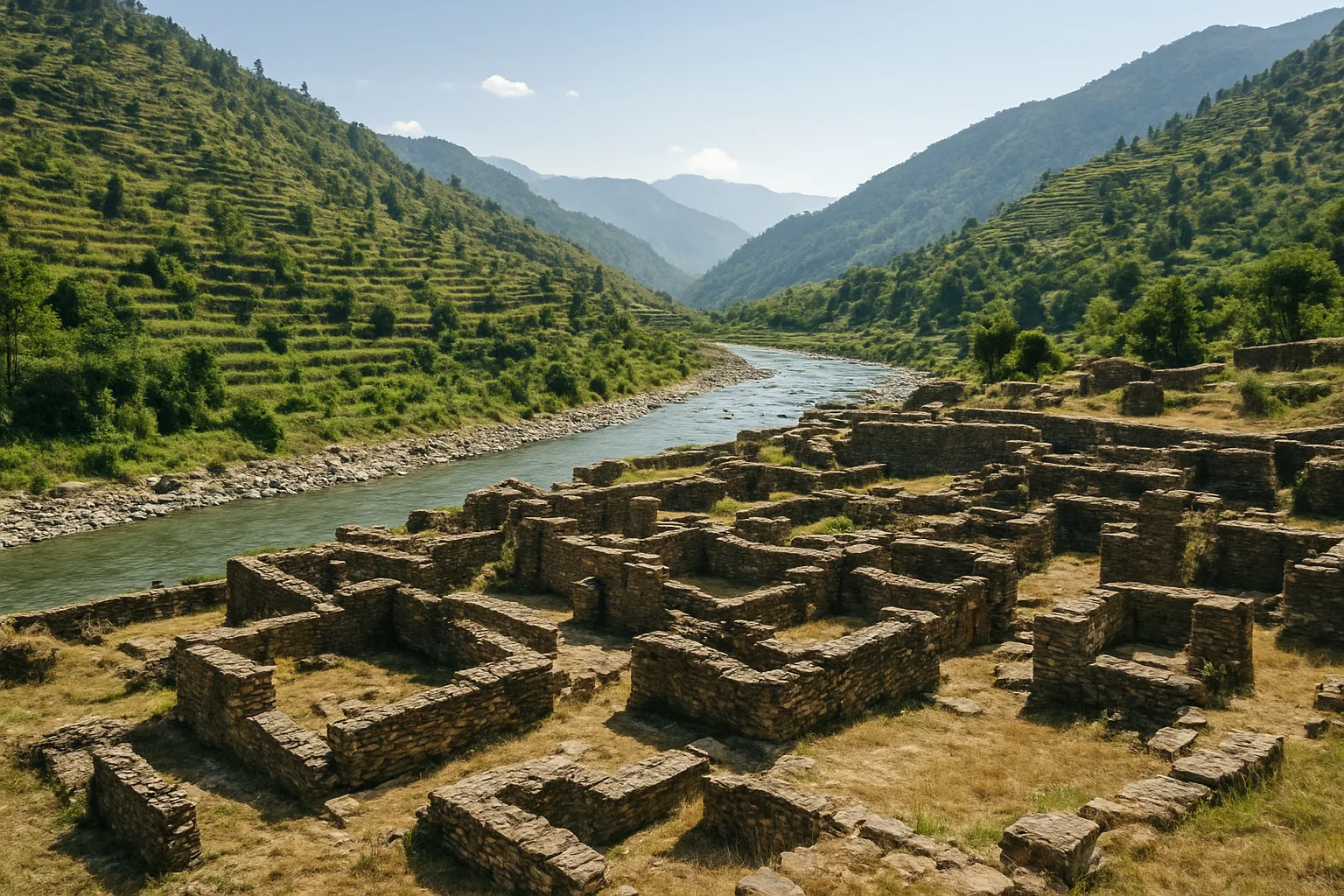
Imagine the hush before sunrise along the Beas River, centuries before the name “Mandi” appeared in chronicles. Wisps of mist rise from the water, curling around smooth river stones and the outlines of distant hills. On the southern banks, the first flickers of firelight dance—signals of human presence in a wild, ancient landscape. Here, in the heart of what we now call Himachal Pradesh, beginnings took root that would shape this region’s identity for millennia.
Geographies of Memory: The Beas as Lifeline
The Beas River, known in ancient times as the Vipasha, carved a deep, fertile corridor through the Western Himalayas. Archaeological surveys and early gazetteers alike point to this valley as one of North India’s oldest human habitats. Its abundant water, rich alluvial soil, and sheltering hills made it a magnet for Stone Age communities seeking both survival and connection.
Stone tools unearthed near the river’s course—axes, scrapers, and blades—suggest that by the Neolithic era (roughly 7000–2000 BCE), groups of hunter-gatherers had already begun settling the region. The Beas was not just a boundary, but a bridge: a vital artery linking the Himalayan foothills to the plains below, and, by extension, to the larger world beyond.
Echoes of the First Settlers
Oral traditions of the region, passed down in song and story, recall a landscape teeming with wild game, dense forests, and a river that both nourished and threatened. Many local legends trace ancestry to ancient tribes—sometimes called the Kol or Koli—who are believed to have been among the earliest settlers along the Beas. These communities lived in small, kin-based clusters, their lives intertwined with the rhythms of river and forest.
Though the details of these first inhabitants remain shrouded in myth, their presence is imprinted on the land. Place names, ritual sites, and seasonal festivals reflect a spiritual worldview in which the river itself was revered as a goddess—one who both sustained and demanded respect.
From Myths to Historical Inference
Distinguishing myth from history is never simple along the Beas. Early Sanskrit texts, including the Mahabharata and Puranic legends, situate the region within the larger cosmology of Himalayan India. The river is described as a boundary crossed by heroes and sages on their way to the legendary north. While these stories serve as cultural anchors, the archaeological and geological evidence provides more concrete clues.
Excavations along the Beas and its tributaries have revealed layers of settlement: from crude stone implements to later pottery shards, indicating a gradual transition from nomadic foraging to settled agriculture. By the first millennium BCE, the valley supported organized communities capable of constructing terraced fields and small hill forts. The emergence of distinct burial practices and megalithic structures—some still visible in the valleys near Mandi—mark the region’s passage into early proto-history.
Belief, Ritual, and Early Social Bonds
Early communities along the Beas were shaped by spiritual beliefs rooted in the land. The earliest forms of worship appear to have centered on natural elements: rivers, stones, and groves. Over time, as contact grew with neighboring valleys and plains, these animistic practices blended with Vedic influences filtering northward from the Punjab. The result was a distinctive hill culture, where local deities and ancestor spirits coexisted with more formalized ritual traditions.
Local chronicles, such as those later compiled in the Mandi State Gazetteer, describe annual fairs and communal gatherings at river confluences—events that likely have their origins in these ancient rites. Even today, echoes of these ceremonies can be seen in the region’s vibrant festivals, where river and mountain are invoked as living presences.
Trade Paths Through the Hills
By the late Iron Age (c. 1000–500 BCE), the Beas valley had become more than a home; it was a crossroads. Early trade routes threaded through the passes, connecting what would become Mandi with Kullu, Lahaul, and the distant plains of Kangra and Punjab. Salt, wool, and metalwork moved along these paths, carried by caravans of traders and nomads. With trade came new ideas—technologies, languages, and belief systems—that deepened the region’s cosmopolitan character.
The ancient settlement of Bhiuli, now submerged by the Pandoh Dam, is often cited in folk memory as a crucial waystation. Early records from neighboring hill states reference “Mandavya Nagar”—a predecessor to modern Mandi—suggesting that the area was already emerging as a point of exchange and cultural synthesis.
Hill States on the Horizon
As the centuries turned, the loosely organized clans and tribal communities began to coalesce into more structured polities. By the early first millennium CE, the proto-states of the Western Himalayas—Kullu, Suket, and others—were taking shape. Mandi’s earliest rulers, the lineage of the Sen and later the Bahu dynasty, would eventually rise from these roots, drawing on both the mythic prestige and the practical networks established by their forebears.
Yet the memory of those first settlements along the Beas never faded. In local tradition, every stone and stream recalls the migrations, struggles, and innovations of ancestors whose names are lost to time. Their legacies endure in the patterns of land use, the layout of terraced fields, and the rituals that still mark each season’s turning.
Enduring Currents: Mandi’s Ancient Foundations
The story of early human settlement along the Beas River is not merely one of survival, but of adaptation and imagination. The interplay of myth and memory, the layering of belief systems, and the forging of social bonds in a challenging landscape—all have left a lasting imprint on Mandi’s character. Even as the modern town grows and changes, these ancient roots remain visible in the rhythms of daily life and the enduring reverence for river and hill alike.
In our next chapter, we will journey forward to the age of early dynasties, tracing how the seeds planted by these first settlers blossomed into the complex, resilient hill states that shaped Mandi’s medieval destiny.
Previous: Ancient Trade Routes That Shaped Early Mandi
Next: The Beas River and Its Role in Mandi’s Early Civilisation