
Series: History of Una, Himachal Pradesh, India
Phase 1: Ancient & Early Roots — Part 1 of 30
This article is part of a broader historical series exploring the earliest layers of human presence in the western Himalayas. Beginning with landscape, belief, and early patterns of movement and settlement, the series traces how communities adapted to mountainous environments long before formal states or written records emerged. These foundational centuries shaped cultural memory, local traditions, and relationships with the land that would endure through later periods of change.
At the Edge of Dawn: A Scene from Una’s Earliest Days
The sunlight crests over the jagged ridges of the Shivalik hills, casting golden rays across the Sutlej’s meandering course. Imagine a small group of travelers—skin bronzed by the sun, feet hardened by the journey—pausing at a riverbank. They carry pots of grain, stone axes, and dreams of a new home. The year is lost to memory, but their presence marks the first human whispers in what would become Una, Himachal Pradesh.
Land of Rivers and Crossroads
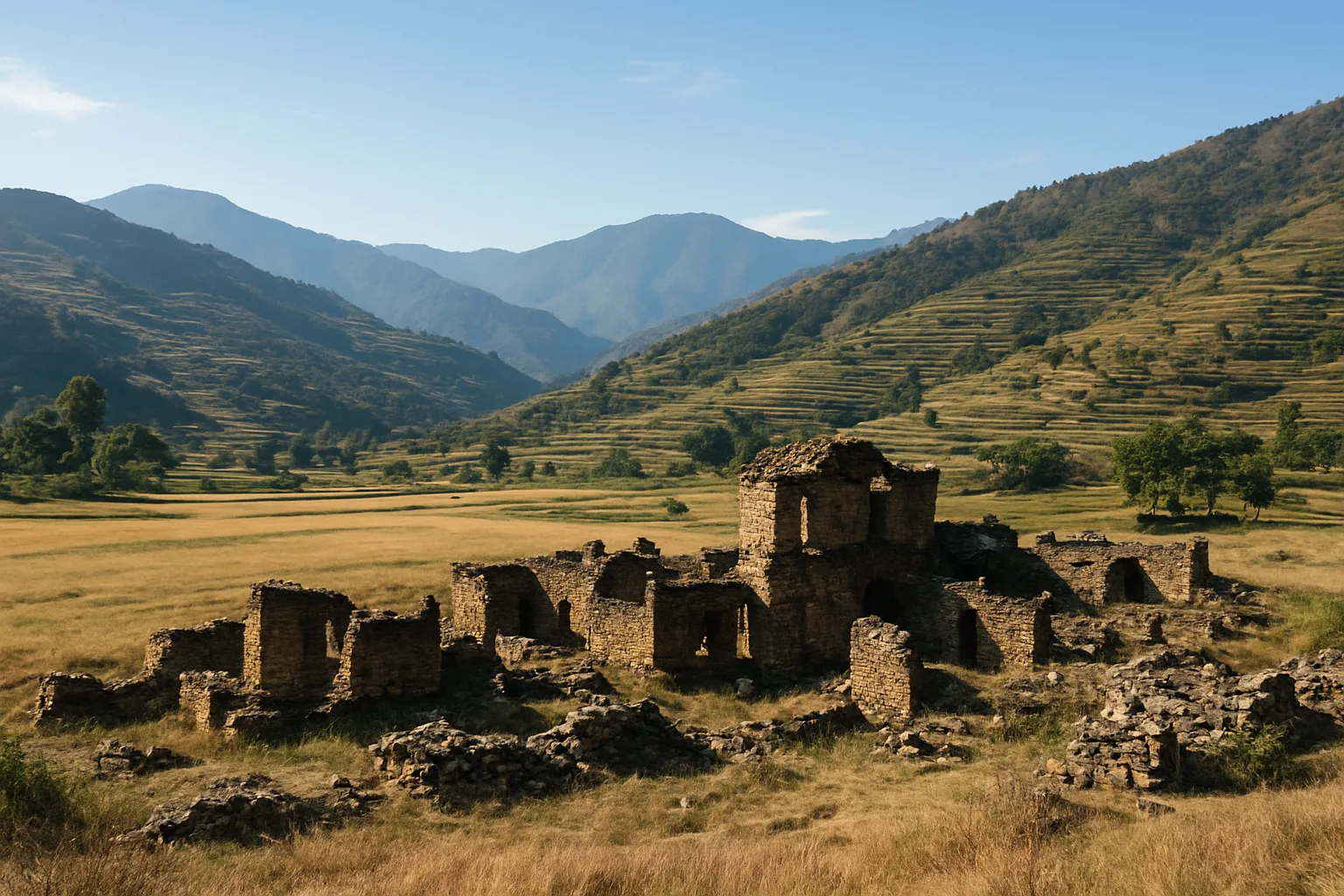
Una’s story begins in the cradle of the Shivalik foothills, a region forever shaped by its geography. The Sutlej and Swan rivers carved out fertile valleys, drawing prehistoric communities to their banks. Archaeological finds in and around the Una district—microliths, pottery shards, and ancient hearths—hint at Neolithic settlements that date back over 4,000 years.
These early inhabitants were not isolated; they lived at a natural crossroads. The Shivalik hills formed a gentle threshold between the northern plains and the Himalayan heights, allowing ideas, goods, and people to flow through. Over time, these valleys would witness the passage of traders, monks, and warriors—each leaving traces in the soil and memory of Una.
Echoes of the Indus and Vedic Worlds
By the third millennium BCE, the pulse of the Indus Valley Civilization could be felt even in the Shivalik’s shadow. Sites like Ropar—just across the hills—flourished as proto-urban centers. While Una itself may have been a quieter outpost, the rhythms of Indus trade, agriculture, and craftwork likely reached its earliest villages. The land’s black-and-red pottery, found in ancient mounds, mirrors styles from the broader Indus sphere.
As centuries turned, the Vedic age dawned. The Rigveda, composed on the plains to the south, speaks of rivers and forests that evoke the landscape around Una. The area’s earliest tribes, such as the Kolis and Doms, would come under the influence of Vedic settlers, adopting new rituals and agricultural techniques. Oral traditions hold that sage Vashishta once wandered these hills, weaving local legends into the broader Indian epic tapestry.
Mahajanapadas and the Shadow of Empires
By the 6th century BCE, the region that includes today’s Una sat on the edge of the Mahajanapada era—a time when city-states vied for power across the northern subcontinent. The powerful kingdom of Trigarta, with its capital at Jalandhar, extended influence into these hills. Trigarta’s rulers, mentioned in the Mahabharata, were said to control vast swathes of land stretching to the Beas and Sutlej rivers.
During this period, the Una hills served as both a refuge and a thoroughfare. Local chieftains, sometimes allied with Trigarta or neighboring kingdoms like Katoch and Audumbara, played the delicate game of survival as empires rose and fell. The arrival of Buddhism and Jainism brought new winds of thought—the monasteries of Kangra and the great stupa at Sanchi were not far, and monks journeyed along the river valleys, sharing teachings and stories.
The Age of Mauryas and the Reach of Ashoka
In the 3rd century BCE, the mighty Mauryan Empire swept northward under Emperor Ashoka. His edicts, carved on pillars and rocks across the subcontinent, advocated tolerance and nonviolence. While few Ashokan relics have been found directly in Una, nearby sites such as Kalsi and Sarnath bear his unmistakable mark. The Mauryan administration brought roads, rest houses, and a new vision of governance to the Himalayan foothills.
Local lore holds that Ashoka’s emissaries may have passed through Una on their way to spread the dhamma. The land absorbed influences from the Ganges heartland, blending them with local customs. Some traditions describe the planting of sacred trees along the riverbanks—a living legacy of Ashokan ideals in the region’s communal life.
Gupta Golden Age and the Rise of Local Princes
The collapse of the Mauryan Empire gave way to regional kingdoms. By the 4th century CE, the Guptas—heralded as ushers of India’s Golden Age—cast a long shadow from Pataliputra to the Himalayan foothills. Artistic motifs, Sanskrit inscriptions, and temple ruins found in Himachal Pradesh speak of this era’s prosperity.
In Una, minor chieftains claimed descent from ancient Kshatriya lineages. They built small forts atop hillocks and sponsored village shrines. Oral tradition recalls the legendary Raja Susharma Chandra, a Katoch king whose descendants ruled nearby Kangra and likely influenced the Una region as well. During these centuries, Una became a patchwork of small domains, each fiercely independent but interlinked by marriage and alliance.
Between Invasions and Syncretic Traditions
The early medieval centuries brought waves of migration and conflict. The Hunas, or White Huns, swept through northern India in the 5th and 6th centuries CE, leaving devastation in their wake. Some sought refuge in the hills of Una, their descendants weaving into the region’s diverse ethnic tapestry.
Yet, even amid upheaval, Una’s communities clung to syncretic traditions. Local deities—like Baba Balak Nath and Chintpurni Devi—became focal points of worship, blending Vedic, folk, and later Buddhist elements. These shrines, nestled on hilltops and beside rivers, became centers for fairs and festivals that still animate Una’s villages today.
The Legacy of Ancient Una in the Modern Era
The ancient roots of Una are more than a matter of archaeology or myth. They shape the district’s landscape, its oral traditions, and the identities of its people. The valleys that once hosted Neolithic settlers now nurture bustling markets and temples. The riverbanks where Vedic sages wandered echo with modern prayers and rituals.
In today’s Una, the past remains palpably close. The rhythms of ancient agriculture persist in terraced fields. The memory of early kingdoms lives on in local folklore and place names. Even as Una grows and changes, its residents carry forward a legacy forged by thousands of years of migration, encounter, and adaptation—a testament to the enduring spirit of the Shivalik foothills.
Next: Geography That Made Una a Gateway to the Hills